Motorized Screens and Power Outages: Battery Backup, Generators, and What to Plan For
Start Your Transformation
How motorized screens get their power, what they do when a Florida outage hits, and how to plan the wiring so a dark afternoon doesn't leave your lanai stuck open or shut.
Quick Answer:
A hardwired motorized screen stops wherever it is when the power goes out and won't move again until power comes back. Battery and solar motors keep working on their charge, which makes them the right fit for openings far from the house. Plan the power source, the circuit, and surge protection before the install , because retrofitting them later costs more.
Florida licensed & insured
Power planned at the measure
In-house install crews
One crew, one contract
By the Right Way Enclosures team — Florida-licensed pool contractor (CPC1461491) and screen-enclosure specialty contractor (SCC131153510 / SCC131153892), serving Central and Eastern Coastal Florida. Last updated: 2026-09-30.
How a Motorized Screen Gets Its Power
Every motorized screen has a small motor tucked inside the roller tube, hidden in the housing above the opening. That motor needs electricity from somewhere. In the industry, there are three common ways to get it there:
- Hardwired. The motor runs on standard household current, wired from a circuit in your house. This is the most common setup and the most reliable day to day.
- Plug-in. The motor cord runs to a nearby outdoor outlet. Simple, but you'll see the cord unless it's routed carefully.
- Battery or solar. A rechargeable battery powers the motor, often topped up by a small solar panel mounted near the housing. No wire back to the house.
Which ones we install on your job depends on the opening and the equipment line. [TRACY: confirm which motor options we install — hardwired, plug-in, battery/solar]
Most Florida homeowners never think about this part. They see a screen go up and down on a remote. But the power source decides what happens on the worst afternoon of the year.
What Actually Happens When the Power Drops
Florida loses power for all kinds of reasons: a summer thunderstorm, a car into a pole, a squirrel in a transformer. When it happens, a hardwired or plug-in motor simply stops.
Here's what that looks like on your lanai:
- The screen stays exactly where it was. Down stays down. Up stays up. Halfway stays halfway.
- The remote does nothing. The remote sends a signal, but the motor has no power to act on it.
- Don't try to force it by hand. Pulling on the fabric or the bottom bar can knock the screen out of its tracks or strain the motor's gearing.
For named storms, there's one rule: roll the screens up while you still have power, well before the wind arrives. Our companion guide on motorized screens and wind in Brevard covers that storm routine in full, so we won't repeat it here.
Battery and Solar Motors: Where They Make Sense
Battery motors solve two problems at once: no wire to run, and no dead screen in an outage. They aren't the answer for every opening, though.
Where they earn their keep:
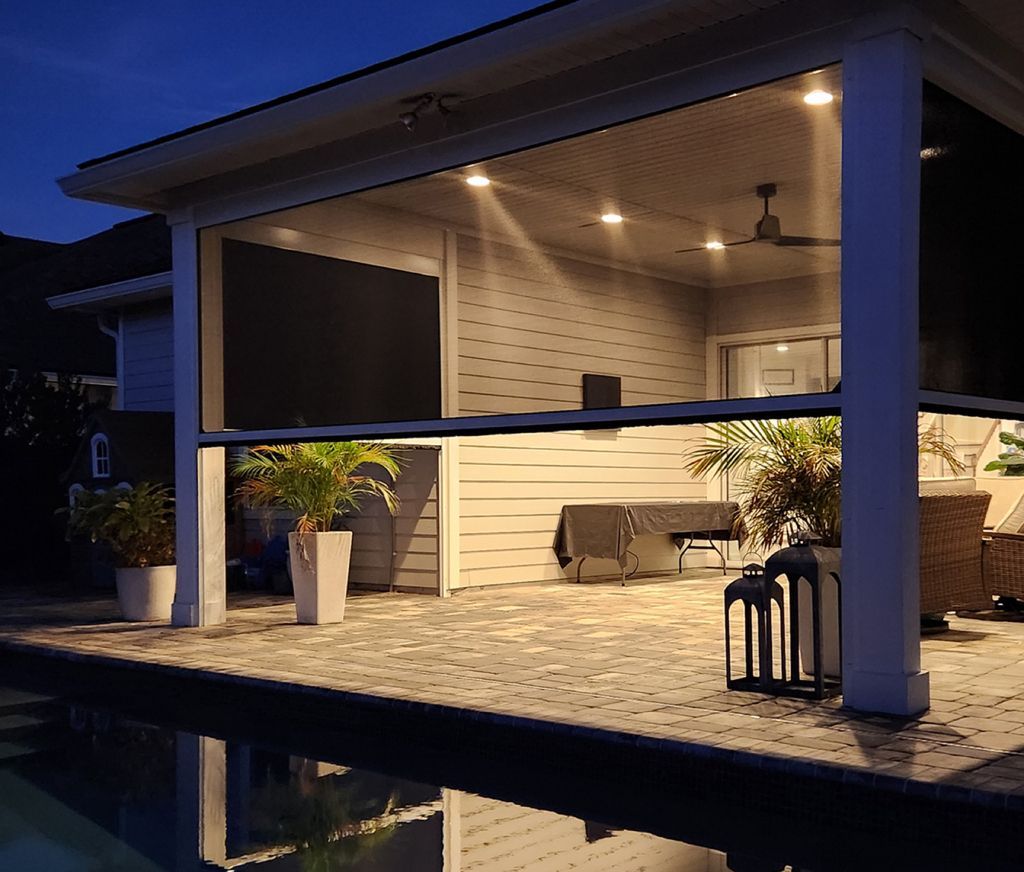
- Detached structures. A pergola across the yard, a cabana, or a pool pavilion where trenching power would tear up the pavers or lawn.
- Openings far from the panel. The back corner of a big pool cage, where a wire run adds real labor.
- Homes that lose power often. If your street goes dark every few storms, a charged battery keeps the screen working.
The trade-offs to know up front:
- Solar needs sun on the panel. A panel under a deep overhang or a live oak canopy may not keep up during a cloudy week.
- Batteries wear out. Like any rechargeable battery, it will need replacing eventually.
- Heavy daily use drains the charge. A screen you run up and down several times a day is better served by a hardwired motor.
For openings that sit under a solid roof close to the house, hardwired is usually the better call. We'll tell you which is which during the measure, opening by opening.
If you're still figuring out where screens would even go, our roundup of creative uses for motorized screens shows the range, from lanais to garage doors.
Running Screens on a Generator
A lot of Florida homes now have a generator, portable or standby. Motorized screens can run on either, as long as the power reaches them safely.
What you need to know:
- Standby generators. If the screens' circuit is one of the circuits your standby generator covers, they'll work as soon as it kicks on. Ask your electrician to confirm the screens are on a backed-up circuit.
- Portable generators. These need a transfer switch or an interlock kit, installed by a licensed electrician, to feed your house wiring. Never plug a generator into a wall outlet to "backfeed" the house. It can send power up the line and hurt utility workers.
- Carbon monoxide. Run a portable generator outside only, well away from doors, windows, and the lanai. The CDC advises keeping it at least 20 feet from the home.
If the screens are plug-in, you can run a heavy-duty outdoor extension cord from the generator straight to the motor cord. Keep that cord off the pool deck and out of standing water.
Surges, Lightning, and Power Coming Back On
Florida is well known as the lightning capital of the country. Strikes nearby and the surge that comes when the grid switches back on are hard on anything with a circuit board, and a screen motor has one.
Steps that help:
- Surge protection at the panel. A whole-home surge protector, installed by a licensed electrician, covers the screen circuit along with everything else.
- Wait before you test. When power returns after an outage, give it a few minutes before running the screens. The first minutes can be unsteady.
- Watch the first run. If a screen stops short, goes past its normal stop, or moves unevenly, stop pressing the button and call us. The travel limits may need to be checked.
Don't open the motor housing yourself. The motor sits inside the roller tube under fabric tension, and that's a job for the crew who installed it.
For routine cleaning of the fabric and tracks, see our separate guide on maintaining a motorized screen system.
Planning the Power Before the Install
The best time to get power right is before the first screen goes up. Once the housings are mounted and the soffits are closed, running new wire gets harder and messier.
📌 Power Checklist Before You Sign
- Which openings get hardwired, plug-in, or battery motors — and why
- Where the power comes from for each hardwired motor
- Whether a new circuit is needed, and who pulls the electrical permit
- GFCI protection on any outdoor outlet the screens use
- Where the wall switch or remote hub will live
A few points to settle during the measure:
- Licensed electrical work. New circuits and wire runs on your house belong to a licensed electrician. Some jobs need an electrical permit from your city or county building department.
- GFCI on outdoor outlets. The National Electrical Code, which Florida adopts through the Florida Building Code, requires GFCI protection on outdoor receptacles.
- Room to grow. If more screens may come later, run capacity for them now.
We plan this as part of one contract, so the screen crew and the electrical work stay on the same schedule and nobody is waiting on somebody else's calendar.
FAQs
Can I raise a motorized screen by hand if the power is out?
Usually not. Most motors hold the screen in place when power drops, and pulling on the fabric can knock it out of its tracks. Some motors offer a manual override, which we can discuss at the measure. Before a Florida named storm, roll screens up early while you still have power.
Are battery-powered motorized screens worth it in Florida?
Yes, for the right opening. They keep working through an outage and need no wire run, which suits pergolas, cabanas, and far corners of a pool cage. Solar panels need real sun, so deep shade can be a problem. We match each Florida opening to the motor that fits it.
Can I run motorized screens off a portable generator?
Yes, if it's connected safely. A licensed electrician should install a transfer switch or interlock so the generator feeds the screen circuit without backfeeding the grid. Plug-in screens can run from a heavy-duty outdoor cord. We coordinate the wiring plan so your Florida screens work during an outage.
Do motorized screens need surge protection?
Yes, it's smart protection. Each motor has electronics that lightning and grid surges can damage, and Florida sees more lightning than most of the country. A whole-home surge protector at the panel covers the screen circuit. We flag it during the measure so your electrician can add it with the new work.
The Bottom Line
A motorized screen is only as dependable as the power behind it. Hardwired motors are the everyday workhorse, battery and solar motors cover the far openings and the outages, and good planning covers the rest.
We plan power at the first visit and build the whole job with one crew under one contract, from a single lanai opening to screens on the open sides of a pool screen enclosure. Garage openings work the same way; our guide to retractable garage door screens shows what that looks like.
Call 772-758-5372 or schedule a consultation at rightwayenclosures.com.
One team. One design. One timeline.
Related services: Motorized Screen Installation · Pool Screen Enclosures · Free Consultation
Companion guide: What Motorized Screens Really Cost in Melbourne — the five things that set the price, including the electrical line.