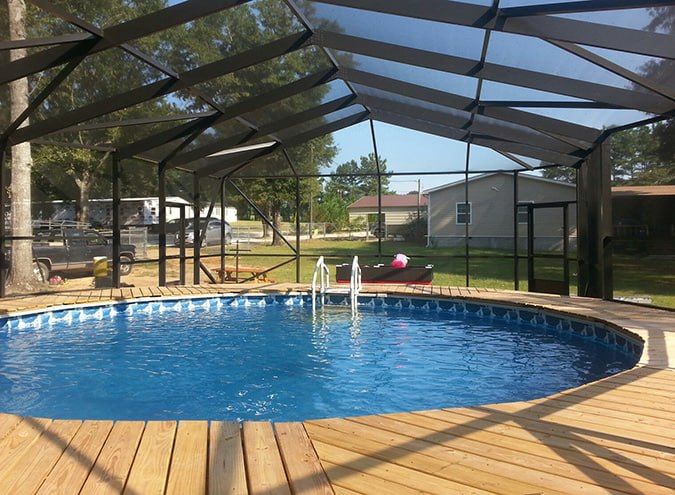
Does a Screen Enclosure Make Your Pool Colder? A Vero Beach Answer
Start Your Transformation
What a pool cage actually does to water temperature in Indian River County — and how mesh, roof style and heater choice change the number.
Quick Answer
Yes, slightly — a screen enclosure usually costs you a few degrees of water temperature in winter, and almost nothing in summer. The mesh shades the water and takes away some solar gain, but the cage also blocks wind across the surface, which cuts evaporation — the biggest way a pool loses heat. In Vero Beach the net effect is small enough that mesh choice, roof style and whether you use a pool cover matter more than the cage itself.
Florida licensed & insured
Indian River County permits
Stainless steel hardware
In-house enclosure crews
By the Right Way Enclosures team — Florida-licensed pool contractor (CPC1461491) and screen-enclosure specialty contractor (SCC131153510 / SCC131153892), serving Central and Eastern Coastal Florida. Last updated: 2026-09-18.
The Honest Answer: A Few Degrees, Mostly in Winter
Homeowners ask us this constantly, usually right before they sign for a cage: am I going to lose my pool?
No. You’re going to lose a little heat on the coldest weeks of the year, and you’re going to gain a pool you can actually use without skimming oak leaves every morning. That’s the trade, and most Vero Beach homeowners take it without a second thought once they understand both halves of it.
Two things are happening at once under a screen enclosure, and they pull in opposite directions:
- The mesh shades the water. Less direct sun hitting the surface means less free heating, and that matters most in December and January when the sun is low and weak anyway.
- The frame and mesh block wind. Moving air across a pool surface drives evaporation, and evaporation is how a pool sheds most of its heat. Cut the wind and you slow the loss.
In June, when the sun is high and the water is already warm, those two roughly cancel. In January, the shading side wins and you notice it — which is exactly the stretch when an unheated Treasure Coast pool was already getting too cold for most people.
If you want the month-by-month picture of Florida swim season, our companion guide on year-round swimming in a Central Florida pool breaks down which months actually work without a heater. This page is about what the cage specifically does on top of that.
What the Mesh Takes Away
Pool screen isn’t one product. The weave you pick changes how much light reaches the water, and it’s the single biggest variable you control.
Standard 18-by-14 pool screen is the most open mesh we install. It’s what’s on most Vero Beach cages, it keeps out mosquitoes and palm debris, and it lets through the most sunlight of any option.
Step to a no-see-um mesh — a much tighter weave built for the tiny biting midges that come off the Indian River Lagoon at dusk — and you get real relief on a barrier-island lot, but a denser screen means a shadier pool. It’s a genuine trade, not a marketing line.
Solar or privacy mesh is denser again. It’s built to block sun and sight lines, and if you put it on the full cage, you should expect a noticeably cooler pool. It’s usually the right call on one or two panels, not the whole structure.
Here’s how we think about mesh on a Vero Beach job:
- Roof panels: keep them open. That’s where most of your solar gain comes from, and it’s not where anybody’s looking in at you.
- The wall facing the prevailing breeze: a tighter weave here buys comfort without costing much light.
- The neighbor-facing wall: privacy mesh, if you want it, without shading the pool from overhead.
- The lagoon or canal side: a no-see-um weave earns its keep at sunset on the water.
If you want the full mesh rundown before you choose, we compared the options in our guide to screen mesh types and bug protection.
What the Cage Gives Back
This is the half of the equation almost nobody accounts for, and it’s the reason the net loss is smaller than people expect.
The U.S. Department of Energy identifies evaporation as the largest source of heat and energy loss from a swimming pool. Every gallon that leaves the surface as vapor takes a meaningful amount of heat with it, and wind moving across the water accelerates the process.
A screen enclosure is, functionally, a windbreak wrapped around your pool. On an open Vero Beach lot — especially out toward the barrier island where the Atlantic breeze runs uninterrupted across Central Beach and Riomar — that wind reduction is not trivial.
What the cage gives you back, beyond temperature:
- Slower evaporation, which means less heat loss and less topping off the water line.
- Less debris, so less organic material sitting on the surface soaking up chemicals.
- Lower chemical demand, because chlorine burns off faster in unfiltered direct sun.
- Shade you can actually use on an August afternoon, when a fully exposed deck is unusable.
📌 What Really Moves Your Water Temperature
- Evaporation is the biggest heat loss — a pool cover beats everything else for holding heat
- Wind across the surface makes evaporation worse; a cage cuts it
- Mesh density matters more than the fact that a cage exists
- A solid or panel roof section blocks sun completely over that area
- Depth and volume: a deeper pool is slower to warm and slower to cool
Roof Style Moves the Number More Than Mesh Does
If you want to protect water temperature, pay attention to the roof before you agonize over the screen.
A mansard or gable roof with open mesh across the whole span keeps the pool under screen only. Light comes through everywhere. That’s the warmest configuration a cage can be.
A hard roof or insulated panel section — the kind homeowners add over a seating area or an outdoor kitchen — blocks sunlight completely wherever it sits. Put that panel over the deck and it costs you nothing. Extend it over half the pool and you’ve built permanent shade on the water.
The peak height matters too. A taller mansard puts the mesh farther above the water, which changes how much of the sky each square foot of water can see through the course of a day.
Before you finalize the roof, walk the plan with these questions:
- Where does the sun actually track across that pool between November and February?
- Which part of the deck needs shade, and can that be solved with a panel section over the deck instead of the water?
- Is the panel roof going over the pool or beside it? That one decision is worth more degrees than any mesh choice.
- What does the structure need to carry? Every RWE enclosure is engineered to a 150 mph FBC wind-load standard, and a panel roof changes the loading — that’s an engineering conversation, not a catalog choice.
We broke the roof options down in detail in our guide to hard-roof screen enclosures, and our Vero Beach enclosure planning guide covers how materials, permits and design decisions stack up locally.
Heating a Caged Pool in Indian River County
If you want December and January back, the cage doesn’t stop you — it just changes which heating options make sense.
Pool heat pumps are the workhorse here. They pull heat out of the air rather than making it, which is why they suit Florida so well: our air stays warm enough to run them most of the year. Their output does fall as air temperature drops, and on the rare Indian River County cold snap you’ll feel that. A cage doesn’t affect a heat pump’s performance at all.
Solar pool heaters are the one place the cage genuinely constrains you — and not the way people assume. Solar collectors go on your house roof, not on the enclosure. A screen cage is engineered to carry wind load and mesh, not rows of water-filled collector panels. If solar heating is in your plan, it’s a roof conversation with your enclosure builder in the room, because panel runs and plumbing have to be routed before the cage goes up.
Pool covers are the least expensive heat you’ll ever buy, and they work fine inside a cage. A solar or thermal cover sits on the water and stops evaporation cold overnight, which is when most of your heat walks off.
A few things worth settling before the enclosure is engineered:
- Where the equipment pad sits relative to the cage, and how you’ll get to it for service.
- Whether a heater is going in now or later — the electrical and plumbing runs are less expensive to rough in once.
- Where a cover reel will live, so it isn’t fighting a knee brace.
- Whether a solar collector run is planned, because that’s a roof and routing decision, not an afterthought.
Design Choices That Buy Back Sunlight
You don’t have to accept the default. Small decisions at design time recover most of what the mesh takes.
Orient the open mesh toward the south and west exposures so the pool sees the winter sun, and save the denser weaves for the north and east walls where the light is weaker anyway.
Keep the panel roof off the water. If the plan calls for a covered section, run it over the deck, the grill or the seating area — the places people actually sit — and leave the water under open screen.
Then handle the rest with the things that were always going to matter more than the cage:
- Use a cover in the cool months. It’s the highest-return move available.
- Trim the canopy. Live oaks over a Vero Beach lot shade the pool far harder than any screen does.
- Consider a darker interior finish if the pool is being built at the same time — darker surfaces absorb more solar gain.
- Build the pool and the enclosure together where you can. One crew, one design, one set of inspections, and the heater, the cover reel and the collector routing all get planned once.
That last one is the real advantage. When the pool, deck and cage are drawn by the same team, nobody discovers in month three that the heat pump is boxed in behind a knee wall.
FAQs
How many degrees will a screen enclosure cool my pool?
Expect a few degrees, and mostly in winter. The mesh shades the water while the frame blocks wind and slows evaporation, so the two effects partly cancel. Mesh density and any solid roof section change it far more than the cage itself. Right Way designs Vero Beach enclosures around the sun angle on your lot.
Can I put solar pool heating panels on top of a screen enclosure?
No. Solar collectors mount on your house roof, not on the cage. A screen enclosure is engineered for wind load and mesh, not for rows of water-filled panels. Plan the collector run and plumbing before the enclosure goes up — Right Way coordinates that routing so nothing gets rerouted later.
Does a pool cover still work inside a screen enclosure?
Yes, and it’s the most effective thing you can do. The U.S. Department of Energy identifies evaporation as a pool’s largest source of heat loss, and a solar or thermal cover stops it overnight. Leave room in the deck layout for a cover reel — Right Way plans that into the enclosure design.
Which screen mesh keeps a Vero Beach pool warmest?
Standard 18-by-14 pool screen. It’s the most open weave we install, so it lets through the most sunlight while still keeping out mosquitoes and palm debris. Tighter no-see-um and privacy meshes shade more.
Thinking about a cage over your Vero Beach pool and worried about the water? Come at it the other way: design the enclosure around how you actually want to use the poolscape, and the temperature question mostly solves itself. We’ll walk the lot, look at the sun angles, and tell you straight what a cage will and won’t do to your water.
One team designs the enclosure, engineers it to code, pulls the Indian River County permit and builds it — no handoffs, no finger-pointing between a screen company and a pool company.
Call 772-758-5372 or schedule a consultation at rightwayenclosures.com. One team. One design. One timeline.
Related services: Pool Screen Enclosures · Pools & Spas · Consultation