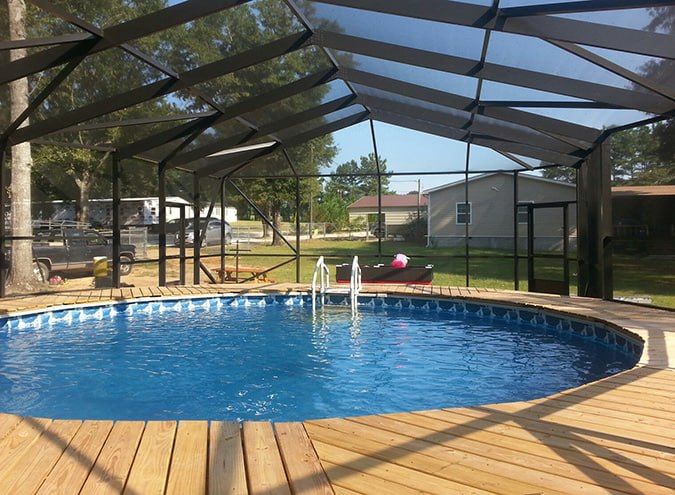
Is an Above-Ground Pool Worth It in Florida? Honest Pros and Cons
Start Your Transformation
A licensed Florida pool contractor's straight answer on when above-ground is the smart buy — and when you should spend the money on in-ground instead.
Quick Answer
For most Florida families, yes — an above-ground pool is worth it if you want swimming this season and you're not trying to raise your home's appraised value. Above-ground installs start at $12,200 all-inclusive and go from delivery to first swim in under 7 days, while a fiberglass pool runs $55,000 to $92,500 and takes under 30 days of build time after permitting. If you want depth for diving, a permanent structure that appraises, or a pool that anchors a full outdoor living space, buy in-ground instead.
By the Right Way Enclosures team — Florida-licensed pool contractor (CPC1461491) and screen-enclosure specialty contractor (SCC131153510 / SCC131153892), serving Central and Eastern Coastal Florida. Last updated: 2026-08-03.
The honest answer: when above-ground wins
An above-ground pool is worth it when the thing you're buying is swim time , not a permanent structure. If the goal is kids in the water this summer without a five-figure jump in scope, this is the product that gets you there.
It stops being worth it the moment your real goal is something else. If you're picturing a pool that raises your appraisal, holds a diving depth, or ties into a paver deck and outdoor kitchen as one designed space, above-ground will disappoint you — and you'll feel it about a year in.
Here's the short version of who it fits:
- Families with kids at home who want a full swim season out of this year, not next year.
- Homeowners on a working budget who'd rather own a good pool now than wait three years for a great one.
- Renters of the long-term variety — people in a house they like but may not retire in.
- Second-property and vacation-home owners who want water on site without a construction project.
- Anyone with a tight or awkward lot where excavation access is genuinely a problem.
That last one matters more in Florida than people expect. Plenty of Melbourne and Vero Beach lots have a screen enclosure, a septic drain field, or a neighbor's fence exactly where an excavator would need to swing.
What it actually costs in Florida
Above-ground pool installs start from $10,000, all-inclusive. That number is the pool, the pad, the structural engineering, the City or County permit, the electrical, and the inspection — not a box on a pallet with an invitation to figure it out yourself.
Your final number moves with a handful of real variables, and any contractor who quotes you before knowing them is guessing:
- Pool size and shape — rounds and ovals price differently, and ovals need more structural support.
- Deck pairing — a wood or composite deck turns the pool into an actual outdoor space, and it's the most common add.
- Screen enclosure bundle — the pool-plus-deck-plus-screen package is the one most Florida families end up wanting.
- Site prep — leveling, sod removal, and how far the electrical has to run from your panel.
- Financing path — terms vary by buyer, and that changes the monthly, not the build.
Compare that against the in-ground side, where our fiberglass Retail Packages run $50,000+. Those packages include full machine excavation, a 3-foot paver border, Pentair SuperFlo VST pump and Clean & Clear Plus filtration, an IntelliChlor salt system, MicroBrite LED lighting, engineering, permits, and inspection coordination.
Side by side, here's how the two products actually compare:
- Starting investment. Above-ground from $10,000 all-inclusive; fiberglass from $50,000.
- Install clock, after the permit. Above-ground is under 7 days to first swim; fiberglass is under 30 days.
- Typical depth. Above-ground is uniform at roughly 4 to 4.5 feet; fiberglass is graduated, up to 5'5" on larger models.
- Appraised home value. Above-ground is treated as personal property; fiberglass is a permanent improvement.
- Removable later. Above-ground, yes. Fiberglass, no.
Financing is available through HFS Financial, Lyon Financial, and Foundation Finance Company for qualified homeowners, which is how a good share of both above-ground and in-ground projects actually get funded.
Not sure which side of that list you're on? Call (772) 758-5372 for a free consultation — we'll tell you straight.
Speed is the real reason families choose it
The brochure line is from delivery to first swim in under 7 days , and that's accurate — but it's the install clock, not the whole project. The countdown starts after the permit is in your hand.
Permit windows are the part no contractor controls. In the City of Sebastian a pool permit typically clears in one to two weeks; unincorporated Indian River County can run two to three months for a pool. Ask your building department for their current window before you plan around a date.
So the honest math looks like this:
- City permit in one to two weeks, then install in under 7 days — roughly three weeks, start to swim.
- County permit at two to three months, then install in under 7 days — the permit is the project, the pool is a week.
- Fiberglass, same permit window, then ground-breaking to first swim in under 30 days — still a season faster than custom concrete.
Anyone promising you a pool "in 7 days" without mentioning the permit office is selling you a timeline they can't hold. That's the same instinct behind our take on buying a pool kit from a big-box store — the sticker looks fast and low-cost right up until the assembly, the pad, and the electrical land in your lap.
What you give up versus in-ground
This is the section most pool companies skip. We'd rather you know now than find out in year three.
Depth is fixed and shallow. Above-ground pools sit at a fairly uniform depth — good for kids, wading, and cooling off, useless for diving. If someone in your house swims laps or wants a deep end, this isn't your pool.
The liner is a wear item. Vinyl liners in Florida sun and chemistry don't last forever, and replacement is a real future cost. Budget for it the way you'd budget for a roof, on a shorter cycle.
It reads as personal property, not a home improvement. An appraiser generally treats an above-ground pool as equipment sitting in the yard, not a permanent structure. It rarely moves the appraised value the way an in-ground pool does.
It's harder to make it look designed. A pool sitting on grass looks like a pool sitting on grass. It takes a wood or composite deck — and usually a screen — before it reads as an outdoor space instead of a purchase.
Resale is a mixed bag. Some buyers see a bonus, some see something they'll have to remove. In-ground pools have a much more predictable effect on a Florida listing.
Here's the flip side, and it's genuinely strong:
- You can take it with you — or take it out — which no in-ground pool offers.
- Lower water volume means less chemical and less heating cost per season.
- No excavation means no spoil pile, no root damage, no equipment tearing up your lawn.
- The whole thing is reversible if life changes in five years.
The Florida-specific stuff nobody mentions
Above-ground pools were designed for the whole country. Florida applies its own set of rules, and this is where a national kit and a Florida installer part ways.
Salt air eats galvanized steel. Standard steel-wall above-ground kits corrode fast near the coast. Our above-ground pools use a resin-coated structure , which is rust-proof and engineered for saltwater systems — the direct answer to the question we get most from Cocoa Beach and Vero Beach buyers.
Sandy soil has to be prepped properly. A pool wall on an unlevel or poorly compacted pad will telegraph that mistake into the liner and the top rail. Professional leveling isn't an upsell; it's the difference between a pool that sits true for years and one that doesn't.
Storms are a design input, not a surprise. Water stays in the pool, but the loose equipment, ladders, and furniture around it are projectiles — our hurricane setup guide for Brevard families walks the whole routine.
Barriers are required, and they're not optional. Florida's pool barrier requirements apply to above-ground pools too. How your city or county interprets pool-wall height, ladder removal, and gated deck stairs varies — confirm it with your local building department before you plan the deck.
Your HOA may have opinions. In deed-restricted communities, above-ground pools are the category most likely to face restrictions or an outright prohibition. Pull your recorded covenants before you sign anything.
📌 The Five Questions That Decide It
- Does anyone in the house need depth? If yes, go in-ground.
- Do you need to swim this season? If yes, above-ground wins on the clock.
- Are you counting on the pool at resale? If yes, in-ground is the safer investment.
- Will you add a deck? Budget it now — it's what makes an above-ground pool feel finished.
- Are you in a deed-restricted community? Read the covenants before you shop.
When you should buy in-ground instead
We install both, so we have no reason to push you the wrong way. Buy in-ground if any of these describe you.
You're building an outdoor living space, not just adding water. If the picture in your head includes a paver deck, an outdoor kitchen, and a screen enclosure that all read as one design, fiberglass is the right foundation for it.
You plan to stay a decade or more. Over ten-plus years, the cost gap narrows considerably once you account for liner replacement and the fact that the in-ground pool is still a permanent improvement at the end of it.
You want a tanning ledge, a spa, or a graduated depth. Those are shell features. No above-ground pool offers them.
Your lot is a good candidate for excavation. If access is clean and the yard has room, you're not fighting the site — which removes one of the main practical reasons to go above-ground.
Not sure which side of that list you're on? Call (772) 758-5372 for a free consultation — we'll tell you straight.
Getting a straight answer for your yard
The right call comes down to your lot, your timeline, and what you actually want to be doing out there in three years. We'll walk your yard, tell you which pool fits, and put the real number in writing — including the parts other contractors leave out until the contract.
One team pulls the permit, preps the pad, sets the pool, builds the deck, and puts up the screen. No handoffs, no five contractors blaming each other.
Call (772) 758-5372 or schedule a consultation at rightwayenclosures.com.
One team. One design. One timeline.
FAQs
Do above-ground pools add value to a home in Florida?
Rarely in appraised value. Appraisers generally classify an above-ground pool as personal property rather than a permanent improvement, so it usually will not raise your home's assessed value the way an in-ground pool does. It can still improve how quickly a family-targeted listing sells.
How long does an above-ground pool last in Florida?
A well-installed resin-coated above-ground pool commonly lasts well over a decade in Florida, but the liner is a wear item that needs replacement sooner. Intense UV, saltwater chemistry, and coastal air all shorten liner life, so budget for that replacement rather than treating it as a surprise repair.
Can you finance an above-ground pool in Florida?
Yes. Right Way works with HFS Financial, Lyon Financial, and Foundation Finance Company, and qualified homeowners can finance an above-ground pool along with a deck or screen enclosure in the same project.
How deep is an above-ground pool?
Most above-ground pools hold a fairly uniform depth of roughly four to four and a half feet, with no deep end and no diving. If someone in your household wants graduated depth, a tanning ledge, or lap swimming, a fiberglass shell is the product that delivers it.
Related services: Above-Ground Pool Installation · Fiberglass Pools · Pool Screen Enclosures