
Hurricane-Ready Above-Ground Pools: 2026 Brevard Family Setup Guide
Start Your Transformation
Above ground pool costs, permits, and decking in Vero Beach and Indian River County
The best hurricane protection for a Brevard above-ground pool happens before June 1 — not 72 hours before landfall. Four things matter most: level, compacted ground; rust-proof, saltwater-ready hardware that survives salt air east of I-95; a pre-season screen enclosure inspection; and dedicated equipment cutoffs. Get those right when the pool goes in, and storm prep becomes simple — lower the water and secure loose items. This guide covers the pre-season setup; for the step-by-step when a named storm is already coming, see our Melbourne watch-to-recovery guide.
Why Pre-Season Setup Beats Last-Minute Scrambling
Hurricane season in Brevard County runs June 1 to November 30 — the same six months your family actually wants the pool. So the pool has to be built for storm season from the day it goes in, not patched together when a system is already in the Gulf.
The Space Coast sits east of I-95, exposed to Atlantic systems, and Melbourne, Palm Bay, Viera, and the beachside strip from Indialantic to Satellite Beach have all taken real storm damage in recent years. That's the environment your pool lives in for half the year.
Here's the pattern we see every season: the families back in the water fastest after a storm are the ones who set the pool up correctly before June 1 — not the ones scrambling 72 hours out. The reactive checklist is easy when the foundation is already right. This guide is about getting that foundation right.
Level Ground: The Foundation That Survives the Storm
The single biggest factor in whether an above-ground pool survives a Brevard storm season is what's underneath it. A full above-ground pool weighs 80,000 to 120,000 pounds depending on size, and that load needs stable, prepared ground — not whatever grade the lawn happens to be.
Florida's sandy soil creates two problems most pool-kit instructions never mention:
- Settlement. Sandy soil compresses unevenly under sustained weight. A pool that's level at install can develop a 2–3 inch tilt in a single season, and that tilt puts uneven stress on the wall, liner, and every hardware connection until something fails.
- Hydrostatic pressure. Brevard's water table sits high, especially near the lagoon and barrier islands. Heavy rain pushes groundwater up against the pool base — and an install on native grade can rack or warp even without a direct hit.
A professional above-ground pool installation starts with a site assessment, leveling, and compaction. That's not cosmetic — it's the engineering minimum for holding 100,000 pounds of water on Brevard soil through a storm season.
Hardware & Equipment Built for Life East of I-95
Salt air is relentless on the Space Coast. Standard galvanized or zinc-coated hardware can corrode in two or three seasons near the Banana River, the Indian River Lagoon, or on a barrier island — and corroded hardware is exactly what lets go in a storm.
Right Way's above-ground pools use a resin-coated, rust-proof structure with heavy-duty, saltwater-ready hardware — built for saltwater systems and for coastal Brevard's humidity, not fighting it. (We recommend a saltwater setup over a chlorine filter for lower upkeep, but we install both.) Getting the structure and hardware right up front is what makes the pool a durable asset instead of an annual repair.
Your equipment setup matters just as much before the season:
- Dedicated electrical cutoffs. Your pump, filter, and heater need permanent, bonded, grounded wiring with a shutoff within arm's reach — never an extension cord, which is a Florida Building Code violation and a real fire risk during a storm.
- Know where the breaker is. When a watch is issued, you'll cut power at the breaker — so confirm now that every piece of equipment has a clearly labeled dedicated circuit.
- Verify an inherited or DIY setup. If you bought the house with the pool, or a previous owner self-installed it, have the electrical and bonding checked before June 1 rather than during a warning.
📌 Before-June-1 Setup Checklist
- ✅ Level, compacted ground under the full pool footprint
- ✅ Resin-coated, saltwater-ready pool structure and hardware
- ✅ Permanent bonded/grounded electrical — no extension cords
- ✅ Labeled equipment cutoffs within reach of the pool
- ✅ Pre-season screen enclosure inspection booked (see below)
- ✅ County permit on file — Brevard permit guide
Central and Eastern Coastal Florida trusted experts in custom pool construction, screen enclosures, concrete, pavers, and outdoor kitchens.
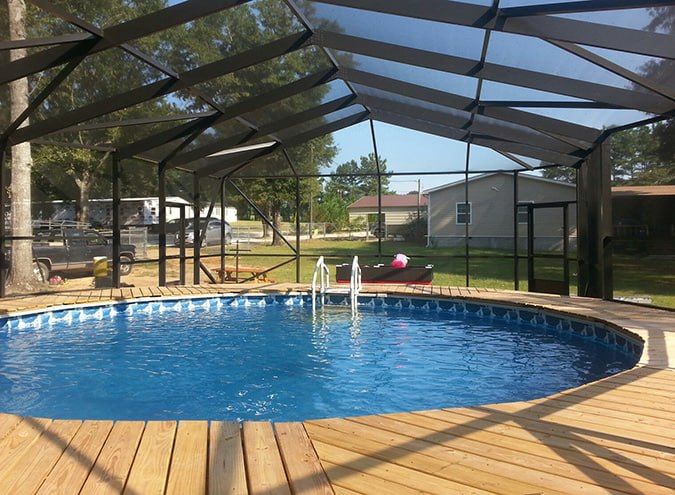
Get the Screen Enclosure Inspected Before June 1
If your pool sits inside a screen enclosure, that structure is your first line of defense — and its weak points don't show up until a storm loads them.
Loose panels, worn caulk lines, and corroded anchor bolts can look perfectly fine in May and fail in a Category 1. A pre-season structural inspection catches them while there's still time to fix them. Right Way screen enclosures are built with high-grade stainless steel hardware standard — the one spec that actually holds up in Florida humidity — but any enclosure, whoever built it, should get a pre-season walk-through.
Here's what a pre-season enclosure inspection should cover:
- Anchor bolts — checked for corrosion and confirmed tight to the slab
- Panels and screening — no loose sections, tears, or separated splines
- Fasteners and caulk lines — re-sealed where worn, since Florida sun degrades them fast
- Doors and latches — hardware that closes and secures fully, so nothing swings open in wind
Do this in May or early June, not when a storm is already named.
When a Storm Is Actually Coming — The Short Version
Once the pool is set up right, storm-day prep is quick. The one rule that never changes: don't drain your above-ground pool. The 15,000+ gallons of water are the anchor holding a lightweight shell to the ground — an empty pool tips in the wind or floats on saturated soil. Instead, you lower the level 1–2 feet below the skimmer, cut power at the breaker, remove the cover, and store loose accessories inside.
That's the summary. The full step-by-step — the watch-vs-warning timeline, what to do if you're evacuating, the after-storm recovery sequence, and the insurance documentation that actually gets claims paid — lives in our companion guide so this page can stay focused on setup:
- Storm on the radar? Read Hurricane Prep for Above-Ground Pools in Melbourne: The Watch-to-Recovery Playbook — the reactive, storm-is-coming version of this guide.
Book Your Pre-Season Inspection
Right Way runs pre-season above-ground pool and screen enclosure inspections for Brevard County homeowners through May and early June — the pool install, hardware, electrical hookups, and enclosure panels and anchors, all checked before the first watch.
If you put your pool in before this season and never had a professional walk-through, June 1 is the wrong time to find out something needs attention. A pre-season inspection takes about an hour and buys you six months of not worrying about it.
Call (772) 758-5372 or schedule a consultation at rightwayenclosures.com. One team. One design. One timeline.
Frequently Asked Questions
When should I get my Brevard above-ground pool ready for hurricane season?
Before June 1, when the season opens. The structural decisions — level ground, saltwater-ready hardware, and a screen enclosure inspection — have to be in place before the first storm, not scrambled together 72 hours out. Book a pre-season walk-through in May so any fixes happen on your schedule, not a hurricane's.
Does an above-ground pool need special hardware to survive Brevard's salt air?
Yes. East of I-95, salt air corrodes standard galvanized hardware in a couple of seasons, and corroded hardware fails in storms. Right Way builds above-ground pools with a resin-coated, saltwater-ready structure, and uses stainless steel hardware on screen enclosures — the specs the coastal Space Coast environment actually demands.
Should I get my screen enclosure inspected before hurricane season?
Yes — every year, in May or early June. Anchor bolts, panels, caulk lines, and door latches that look fine in spring can fail under Category 1 wind loads. A pre-season structural inspection catches loose or corroded hardware while there's still time to fix it before a storm arrives.
Why does level ground matter so much for storm survival?
A full above-ground pool weighs 80,000–120,000 pounds, and Brevard's sandy soil settles unevenly and holds a high water table. An install on unprepared grade can tilt, rack, or warp under that load — even in heavy rain without a direct hit. Professional leveling and compaction is the foundation everything else depends on.