Is Your Pool Cage Safe in a Brevard Thunderstorm?
Start Your Transformation
Melbourne, Palm Bay, and Titusville sit in the most lightning-prone corridor in the country — here's what that means for an aluminum screen enclosure.
Quick Answer: An aluminum screen enclosure does not attract lightning — height and isolation do, and your cage is lower than your roof. What it also isn't is a safe place to ride out a storm: an open-sided structure gives you no protection at all. Get out of the water and into the house at the first rumble of thunder, and stay there 30 minutes after the last one.
In This Article
- No, Your Pool Cage Doesn't Attract Lightning
- Why Brevard Gets So Much of It
- The Cage Is Not a Storm Shelter
- Bonding — the Code Requirement Nobody Explains
- What Lightning Actually Breaks Around a Pool
- What to Check on an Older Brevard Cage
- FAQs
Florida licensed & insured
Brevard County permit-pulling
Stainless steel hardware
In-house enclosure crews
By the Right Way Enclosures team — Florida-licensed pool contractor (CPC1461491) and screen-enclosure specialty contractor (SCC131153510 / SCC131153892), serving Central and Eastern Coastal Florida. Last updated: 2026-09-16.
No, Your Pool Cage Doesn't Attract Lightning
This is the question we get every summer, usually from somebody who's been talked out of an enclosure by a neighbor. The answer is no, and the reasoning is worth understanding.
Lightning doesn't seek out metal. It takes the path of least resistance to the ground, and what decides that path is height and isolation — how far something sticks up, and how alone it stands. Material barely enters into it.
Look at where your cage actually sits:
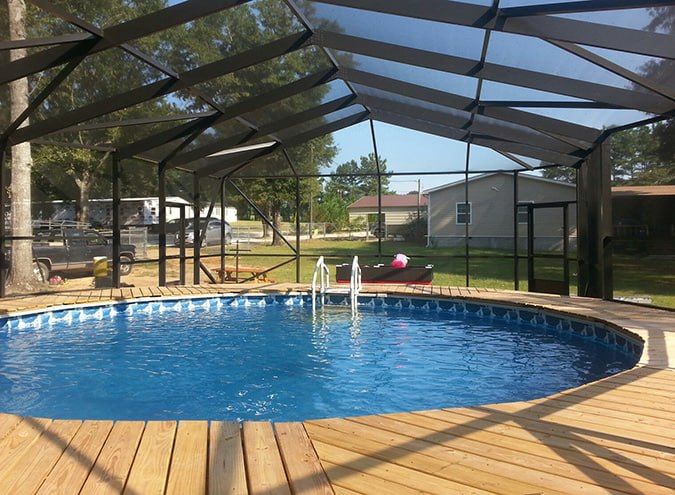
- It's shorter than your house. A pool enclosure tops out below the roofline on almost every Brevard home we build on.
- It's not isolated. It's surrounded by a two-story house, mature oaks and palms, light poles, and utility lines.
- It's not grounded like a rod. The columns sit on a concrete footer or deck, not driven into wet earth.
If lightning is going to hit your property, the roof, a tall pine, or the power drop at the street is a more attractive target than a ten-foot aluminum frame standing next to a house.
That's not a guarantee — nothing about lightning is. It just means the cage isn't the reason you're at risk.
Why Brevard Gets So Much of It
The reason this question comes up here and not in Ohio is that Central Florida genuinely is the lightning capital of the United States. Florida leads the country in both strikes and lightning deaths, year after year.
The corridor that runs roughly from Tampa across to Titusville gets the worst of it, and Brevard sits on the eastern end of it. The mechanism is our two sea breezes:
- The Atlantic sea breeze pushes inland from the coast through the late morning.
- The Gulf sea breeze comes the other way across the peninsula.
- Where the two collide , the air has nowhere to go but up — and that's the afternoon storm.
Some days that collision line sits over Palm Bay and Melbourne. Other days it forms out over the St. Johns marshes west of I-95 and drifts back east over Viera and Suntree in the evening. Either way, from roughly June through September, the odds of a storm between two and seven in the afternoon are high enough to plan around.
It's not a coincidence that the pads at Kennedy Space Center are ringed by some of the most serious lightning protection anywhere. We build in the same weather.
Thinking about a screen enclosure in Melbourne, Palm Bay, or Viera? We'll walk the site, explain the engineering, and put the whole thing on one contract. Call (772) 758-5372 to set up a consultation.
The Cage Is Not a Storm Shelter
Here's the part that actually matters for your family's safety, and it's the opposite of what most people assume.
A screen enclosure looks like shelter. It has a roof outline, posts, a door. It is not shelter. The National Weather Service is blunt about this: open structures — carports, picnic pavilions, screened porches, pool cages — give you no protection from lightning, because there's no continuous metal shell and no grounded wiring or plumbing to carry the current around you.
What's safe is a substantial building or a hard-topped vehicle. Your house counts. The cage does not.
The rule we give every homeowner:
- At the first thunder, everyone out of the pool. Water is the single worst place to be, cage or no cage.
- Go inside the house — not the cage, not the covered lanai, not the garage with the door up.
- Stay off the pool equipment. Don't touch the pump, the heater, or the metal handrail during the storm.
- Wait 30 minutes after the last thunder before anyone goes back in.
An enclosure buys you a lot in Brevard — no bugs, no oak debris, less chlorine burn-off, a pool you actually use nine months a year. Storm protection just isn't on the list, and any contractor who tells you otherwise is selling.
Bonding — the Code Requirement Nobody Explains
There's a genuine electrical requirement attached to a pool cage, and it has nothing to do with direct strikes. It's called equipotential bonding, and it's the reason your enclosure columns get a copper wire clamped to them.
The National Electrical Code — adopted in Florida through the Florida Building Code — requires metal structures within five feet of the pool's inside wall to be tied into the pool's bonding grid. A cage column standing inside that five-foot ring counts.
What bonding actually does:
- It equalizes voltage. Everything metal you can touch sits at the same electrical potential, so there's no difference for current to travel across.
- It protects against stray voltage , not lightning — a failing pump motor or a nicked underground conductor is the realistic hazard.
- It's an inspected item. The bonding connections get looked at before the deck gets covered, which is why a legitimate permit matters.
- It has to be maintained. Bonding clamps corrode in Brevard's salt-laden air, and a corroded clamp is an open circuit.
This is one of the reasons we pull the permit and run the inspections on every enclosure we build. A cage that went up without a permit also went up without anyone verifying the bonding.
If your pool cage was built before you bought the house — or built without a permit — a licensed contractor should look at the bonding and the anchors before another storm season. Call (772) 758-5372 and we'll take a look.
What Lightning Actually Breaks Around a Pool
The damage we get called about after a Brevard lightning event is almost never structural. It's electronic.
A strike doesn't have to hit your house to cost you. A nearby strike induces a surge that travels in on the power lines and the underground feeders, and the pool equipment pad is full of things that don't survive it:
- Variable-speed pump drives. The electronics in a modern pump are the most expensive and most vulnerable thing out there.
- Salt cell power supplies and heater control boards. Same story, smaller bill.
- LED transformers. The low-voltage supplies behind pool and screen enclosure lighting go first in a lot of these.
- Ceiling fans and outlets in the cage. Anything on a branch circuit that runs out to the enclosure.
The mitigation is unglamorous: a whole-home surge protective device at the main panel, plus GFCI protection on every enclosure circuit, which is already required near a pool. Neither is expensive relative to a pump drive.
Storm damage to the enclosure itself is a wind conversation, not a lightning one — our guide to screen enclosure insurance in Brevard County covers how those claims tend to work.
What to Check on an Older Brevard Cage
If your enclosure has been standing through a few seasons, there's a short list worth walking before the next one. None of it takes long.
Go look at these:
- The bonding clamps at the column bases. Green corrosion, a loose wire, or no wire at all are all findings.
- Anchor condition. Salt air eats fasteners. If the anchors aren't stainless, they're on a clock — one reason stainless steel hardware is the standard on every enclosure we build.
- Fan and light fixtures. Anything that flickered after the last storm is telling you something.
- The GFCI test buttons. Press them. They should trip and reset.
- Screen and door hardware before storm season, per our hurricane prep checklist for screen enclosures.
We build to the 150 mph Florida Building Code wind-load engineering standard across the service area, inland and beachside alike, and that structure is only as good as the hardware holding it down. An older cage with budget fasteners is a different animal from a new one.
FAQs
Does a screen enclosure attract lightning?
No. Lightning follows height and isolation, not metal, and a pool cage sits below your roofline surrounded by the house, trees, and utility poles. In Brevard County the taller targets nearby are far more likely. The frame isn't why your property is at risk during a storm.
Is it safe to sit in my pool cage during a thunderstorm in Melbourne?
No. The National Weather Service classifies open structures — pool cages, carports, screened porches — as offering no lightning protection, because there's no enclosed metal shell to carry current around you. Go into the house at the first thunder and wait 30 minutes after the last one.
Does my pool cage have to be connected to the pool's electrical bonding?
Yes. The National Electrical Code, adopted in Florida through the Florida Building Code, requires metal structures within five feet of the pool's inside wall to be bonded into the pool's grid, and enclosure columns in that ring qualify. Right Way pulls the permit so the connection gets inspected.
Can lightning damage my pool pump through the screen enclosure?
Yes, but not through the frame — through the wiring. A nearby strike sends a surge down the branch circuits feeding the equipment pad, and variable-speed pump drives, heater boards, and LED transformers are the usual casualties. A surge protective device at the main panel is the practical defense.
Build It Once, Build It Right
A pool cage in Brevard County has to answer to salt air, 150 mph engineering, an afternoon storm pattern that runs four months a year, and an electrical code that takes the water seriously. That's a lot to get right, and it's why we don't hand any of it off.
Right Way designs, permits, builds, and inspects pool screen enclosures across Melbourne, Palm Bay, Viera, Satellite Beach, and Titusville with our own crews — engineering package, bonding, anchors, stainless hardware, and final inspection under one contract.
Call 772-758-5372 or schedule a consultation at rightwayenclosures.com. One team. One design. One timeline.
Related services: Pool Screen Enclosures · Consultation
Companion guide: Screen Enclosure Insurance in Brevard County covers what your policy does and doesn't pay for after storm damage — this page covers the lightning question itself.