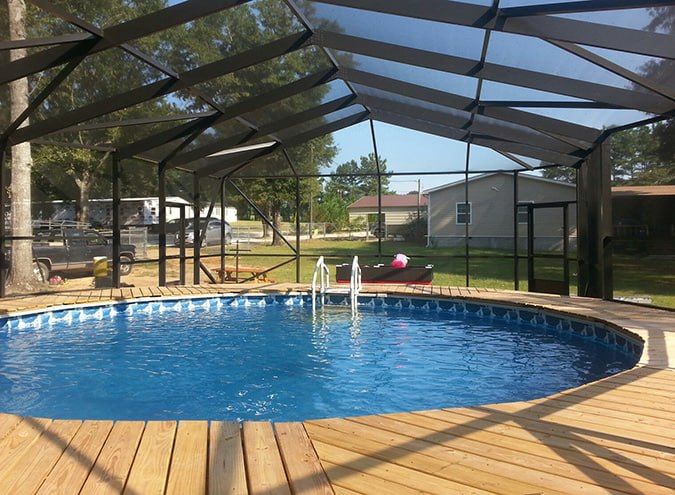
Is Your Pool Cage Covered by Insurance? A Brevard County Reality Check
Start Your Transformation
What a Florida homeowners policy actually says about your screen enclosure — and the paperwork that decides whether a storm claim gets paid.
Quick Answer
Usually yes, but not the way most homeowners assume. A pool screen enclosure is typically insured as a detached or "other structure" — or under a separate screened-enclosure endorsement — not as part of your main dwelling coverage, and in Florida that means your hurricane deductible often applies before anything gets paid. Pull your declarations page and find the enclosure line before storm season, not after.
By the Right Way Enclosures team — Florida-licensed pool contractor (CPC1461491) and screen-enclosure specialty contractor (SCC131153510 / SCC131153892), serving Central and Eastern Coastal Florida. Last updated: 2026-08-03.
What your policy actually covers
Here's the part that surprises people in Melbourne and Palm Bay every single storm season: your pool cage is generally not treated as part of the house.
Most Florida homeowners policies handle a screen enclosure one of two ways. It falls under the "other structures" coverage that also covers your fence and shed, or it's written in as a specific screened-enclosure endorsement with its own limit.
Either way, that limit is usually a fraction of your dwelling coverage — and it's shared. If a storm takes your fence, your shed, and your pool cage, they're all pulling from the same pot.
Before you assume anything, go find these lines on your declarations page:
- Is the screen enclosure named at all? Some carriers exclude it outright unless it's specifically endorsed.
- What's the dollar limit on other structures or the enclosure endorsement?
- Is it replacement cost or actual cash value? Actual cash value depreciates an aging cage, and the check reflects that.
- What's your hurricane or windstorm deductible , and is it a percentage rather than a flat amount?
- Are screens and mesh treated differently from the aluminum frame?
That last one catches more Brevard homeowners than any other item on the list.
The hurricane deductible is the real number
Florida policies commonly carry a separate hurricane deductible calculated as a percentage of your dwelling coverage — not a flat few hundred dollars like your regular deductible.
Run that math on your own policy before a storm, because it changes the entire calculation. On a lot of Brevard homes, the hurricane deductible lands somewhere near — or above — what a full screen enclosure replacement costs.
Which leads to the uncomfortable truth nobody at the insurance company volunteers: for screen-only damage, you may be paying out of pocket regardless. A torn panel or two almost never clears the deductible.
That's not a reason to skip coverage. It's a reason to know which repairs are genuinely a claim and which are just a Tuesday:
- A few torn panels after a squall — repair cost, not a claim. Filing does nothing but put a claim on your record.
- Frame damage across one or two bays — worth pricing out before you decide.
- A collapsed or twisted structure after a named storm — that's the claim your policy exists for.
- Damage to the house caused by the failing cage — different coverage entirely, and dwelling coverage may apply.
Our breakdown of what actually drives screen enclosure costs is worth reading alongside your declarations page — it's hard to judge a coverage limit without knowing what a rebuild runs.
Where Brevard claims get denied
Adjusters deny screen enclosure claims for a short, repetitive list of reasons. Nearly all of them are avoidable.
Pre-existing wear. This is the big one on the barrier island. Salt air off the Atlantic and the Indian River Lagoon corrodes fasteners and chalks anodized aluminum over years, and an adjuster who sees a rusted, sagging cage will call it deferred maintenance rather than storm damage.
No proof of the "before" condition. If you can't show what the enclosure looked like the week before the storm, you're arguing from memory against a professional whose job is to say no.
Unpermitted or non-engineered work. A cage that was replaced or modified without a permit is a gift to a claims department. So is a repair done by someone unlicensed.
Screen-only exclusions. Many policies limit or exclude damage to the mesh itself while still covering the structure — read that clause specifically.
Late reporting. Policies carry deadlines for reporting storm damage. Waiting until you get around to it is how a valid claim becomes an expired one.
The Satellite Beach and Indialantic homes we service show this pattern most clearly. Salt-edge exposure ages hardware faster than inland Palm Bay, and a cage that hasn't been maintained gets classified as worn out rather than storm-damaged.
What to document before storm season
The single highest-value thing you can do costs nothing and takes twenty minutes.
Walk the enclosure with your phone before hurricane season and shoot it properly — wide shots of every elevation, then close-ups of the corners, the fasteners, the super gutter, and the door hardware. Date-stamped photos are what turn "it was already like that" into a paid claim.
Keep the rest of the file with it:
- Your original permit and engineering documents from the build or the last major repair.
- The contractor's invoice showing scope and materials.
- Photos from before each storm season , refreshed annually.
- Maintenance records — rescreening, repainting, fastener replacement.
- Your declarations page , so you're not hunting for it while the power's out.
📌 Your Pre-Storm Pool Cage File
- Date-stamped photos of all four elevations, refreshed every June
- Close-ups of corners, fasteners, super gutter, and door hardware
- Original permit + engineering documents
- Contractor invoices for the build and every repair since
- Declarations page with the enclosure coverage line highlighted
Pair that file with our hurricane prep checklist for screen enclosures and you've covered both the physical prep and the paperwork side.
Building it so it survives in the first place
The best insurance outcome is the claim you never file. That's a build-quality question, and it's decided by two things: the engineering and the hardware.
Every enclosure we build is engineered to the 150 mph FBC wind-load standard across our service area, and permitted and inspected through the Brevard County or city building department that has jurisdiction. That permit record is also the document that protects you later.
Stainless steel hardware is the standard on every Right Way screen enclosure — galvanized fasteners rust in Florida humidity, and a corroded fastener is exactly the "pre-existing wear" an adjuster is looking for. On the barrier island, hardware is the difference between a cage that ages well and one that gets written off.
Be realistic about the maintenance, too. Screen mesh is a wear item with a service life measured in years, not decades, and UV exposure is what ends it. Rescreening on a sensible cycle keeps the whole structure classified as maintained rather than neglected.
Get a straight assessment of your enclosure
If you're not sure whether your cage would survive a real storm — or a real adjuster — have someone who builds them look at it. We'll walk the structure, flag the corroded hardware and the weak connections, and tell you whether you're looking at a repair, a rescreen, or a rebuild.
One team engineers it, permits it, builds it, and repairs it. No handoffs, no five contractors pointing at each other while your pool fills with leaves.
Call (772) 758-5372 or schedule a consultation at rightwayenclosures.com.
One team. One design. One timeline.
FAQs
Does homeowners insurance cover a screen enclosure in Florida?
Usually yes, but typically under "other structures" coverage or a specific screened-enclosure endorsement rather than your dwelling coverage. That means a separate, smaller limit that may be shared with your fence and shed. Check your declarations page for the exact line before you assume you're covered.
Do I need a separate rider for my pool cage?
Often, yes. A number of Florida carriers either exclude screen enclosures or cap them severely unless you add a specific endorsement. Call your agent and ask directly whether your pool cage is scheduled, what the limit is, and whether it pays replacement cost or depreciated actual cash value.
Will insurance pay to replace just the torn screens?
Rarely. Screen-only damage almost never exceeds a Florida hurricane deductible, which is commonly a percentage of dwelling coverage rather than a flat amount. Many policies also limit mesh damage separately from the aluminum frame, so rescreening is usually an out-of-pocket maintenance cost.
Should I file a claim for minor pool cage damage?
Generally no. If the repair costs less than your hurricane deductible, filing gains you nothing and adds a claim to your record. Price the repair first, compare it against the deductible on your declarations page, then decide. Structural or collapse damage is a different conversation.
Related services: Pool Screen Enclosures · Above-Ground Pool Installation · Paver Installation
Companion guides: Hurricane Prep Checklist for Screen Enclosures · What Drives Screen Enclosure Costs