HOA Approval for Motorized Screens in Vero Beach: What the Committee Actually Checks
Start Your Transformation
A screen that rolls up out of sight still has to clear the architectural committee. Here's what a Vero Beach ARC looks at on a motorized screen, what goes in the packet, and the Florida rules your association has to follow.
Quick Answer:
Plan on HOA approval before motorized screens go up , even though they roll away when you're not using them. The committee reviews what neighbors see: the housing color, the side tracks, and the fabric when it's down. Florida Statute 720.3035 limits review to what your declaration actually authorizes and requires any denial in writing, citing the specific rule.
Florida licensed & insured
SunPro motorized screens
Hardwired or plug-in motors
3-year workmanship warranty
By the Right Way Enclosures team — Florida-licensed pool contractor (CPC1461491) and screen-enclosure specialty contractor (SCC131153510 / SCC131153892), serving Central and Eastern Coastal Florida. Last updated: 2026-10-12.
Why a Screen That Rolls Away Still Needs Approval
This is a nuts-and-bolts guide for Vero Beach homeowners who've already decided on motorized screens and now have to get them past the HOA. If you're still choosing between fixed and motorized, start with our fixed vs. motorized screens comparison.
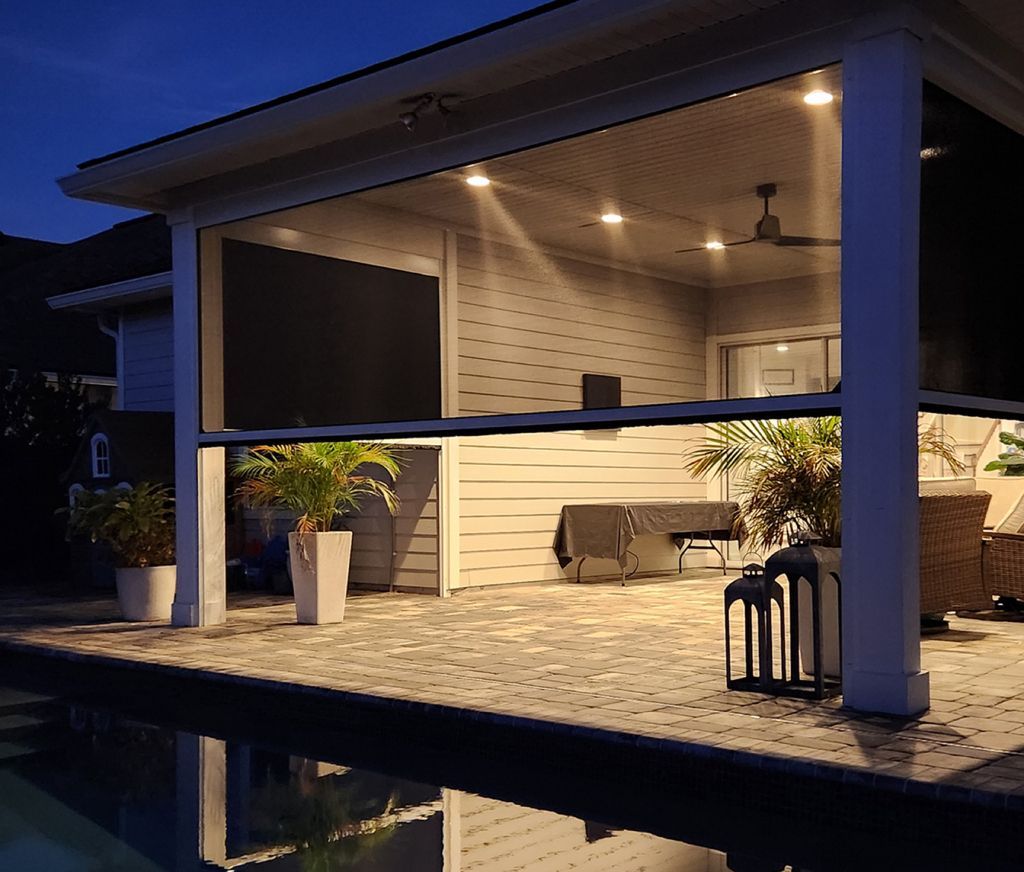
A common assumption is that a screen that disappears into a housing isn't really a change to the house. Your committee won't see it that way. The housing, the tracks, and the bottom bar stay on the house all year, and when the screen is down, it changes how the lanai looks from outside.
Florida Statute 720.3035 gives your association architectural review power only to the extent the declaration or published guidelines state it or reasonably imply it. If you live in a gated or master-planned community such as Grand Harbor or The Moorings, your declaration's architectural section is the first document to read.
What triggers review:
- Visibility. The statute keeps associations out of interior work that can't be seen from the frontage, a neighbor's lot, common area, or a golf course. A lanai screen facing a fairway or the lagoon is in plain view.
- Exterior attachment. The housing mounts to your header or fascia and the tracks fasten to the columns or wall.
- Color and material. Declarations commonly control exterior colors, and the screen adds three of them: housing, track, and fabric.
What the Committee Looks At on a Motorized Screen
An architectural committee reviewing a motorized screen is mostly reviewing color and placement. Knowing the options ahead of time saves a round of resubmittals.
The parts they'll ask about:
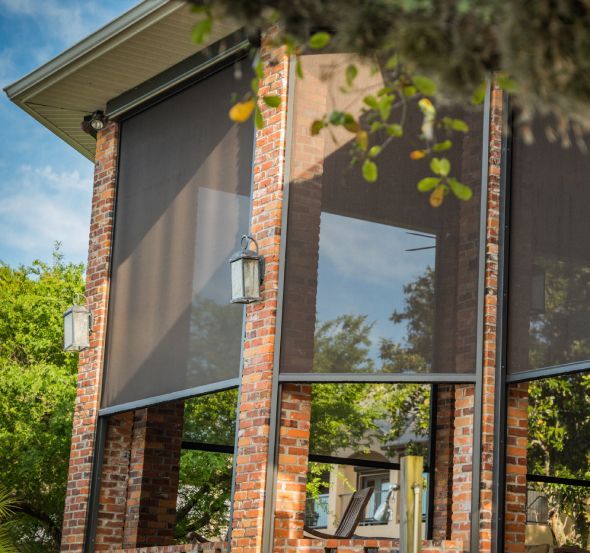
- The cassette housing. SunPro's integrated cassette housing is powder-coated and comes in five colors: white, black, beige, bronze, and ivory, with custom colors available on request. Matching your trim or fascia often makes for the simplest review.
- The tracks. SunPro offers a traditional track for retrofits and a recessed track for custom built-ins, where the tracks and housing are hidden from view. SunPro lists the recessed track as a pre-construction option, so a retrofit on an existing lanai uses the traditional track.
- The bottom bar. SunPro offers several bottom bar options in various colors, with brush or rubber seals.
- The fabric when lowered. From the street or the fairway, a lowered screen reads as a panel of color. Fabric choice is its own decision, covered in our motorized screen fabric guide, but the committee will want to know the color.
- Where it mounts. Inside the lanai opening or on the outside face, and whether any housing hangs below the header line.
Front-facing openings draw the closest look. If you're thinking about screening a garage door or a front entry too, our posts on retractable garage door screens and screened front entryways cover those openings.
Building a Packet for a Screen That Moves
The general rules for an ARC submittal in Vero Beach are covered in our screen enclosure HOA approval guide. A motorized screen adds one wrinkle: the committee has to picture it in two positions.
What to put in a motorized screen packet:
- Photos of each opening with the housing location and track lines marked.
- The product information. SunPro's published specs for the housing, track type, and bottom bar.
- Color selections. Housing, track, and bottom bar colors, plus a fabric sample or swatch photo.
- Both positions. A photo or sketch with the screen up (housing only) and with the screen down.
- Every opening. List each one you plan to screen, so the approval covers all of them.
- The controls. A wireless remote or voice control through smart devices, per SunPro. No new equipment sits outside the house.
Get the approval before the order goes in. SunPro custom-makes each screen to its opening, from 3 to 30 feet wide and up to 20 feet high, so the housing color and fabric are locked once the screens are built. Changing a color after the committee says no is a lot easier on paper than on a finished screen.
Check your declaration's architectural section before you pick colors. Under 720.3035(2), if the declaration lists approved options for materials, colors, or design, the association can't stop you from choosing among them.
The Florida Rules Your Association Has to Follow
Florida Statute 720.3035 puts real limits on how an HOA runs architectural review. Knowing them keeps the process fair on both sides.
The points that matter for a screen application:
- Authority comes from the documents. Review power exists only as far as the declaration or published guidelines state it or reasonably imply it, applied reasonably and equitably to every owner.
- No permit first. The association can't require a government building permit as a condition of reviewing your application.
- Denials in writing. A denial must be written and name the specific rule or covenant relied on and the part of your plan that doesn't conform.
- No side policies. The association can't enforce a policy that conflicts with the rights in your declaration.
- Remedies exist. If an association unreasonably, knowingly, and willfully infringes those rights, the statute lets the owner recover damages, costs, and attorney fees.
That last point is a backstop, not a strategy. If a denial looks wrong, read the cited rule, adjust the colors or mounting, and resubmit before you call a lawyer. Living on Ocean Drive in a condo? Condominiums run under a different statute, Chapter 718, so check your condo documents and board process instead.
Don't File It as Hurricane Protection
Section 720.3035(6) requires every HOA to adopt hurricane protection specifications and bars denial of a conforming application. The statute lists storm shutters, impact-resistant windows and doors, and similar items.
A motorized screen is not on that list, and it isn't storm protection. SunPro says its solar screen can block up to 85% of the wind and rain in the screened area. That's comfort on a stormy afternoon, not a hurricane shutter.
So submit it as what it is:
- A screen, reviewed under your community's exterior-change rules.
- Not shutters, and never described as storm or hurricane protection in the packet.
- Not a substitute for the shutters or impact glass your house already has.
Calling it hurricane protection to speed up approval invites a denial and sets the wrong expectation for the first named storm.
After Approval: Power, Permit, and the Install
HOA approval and the building department are separate tracks. In Vero Beach and unincorporated Indian River County, the county Building Division handles permitting, and its staff can tell you what your specific project needs.
What comes next once the committee says yes:
- Power. We install SunPro motors hardwired or plug-in, so plan for a circuit or an outlet within reach of each housing.
- Motor choice. SunPro offers Dooya and Somfy motors.
- Install to the approval. Housing color, track type, and mounting location should match the approved packet exactly. A swap in the field is how a finished job ends up back in front of the committee.
- Warranty. SunPro warrants hardware for life, fabric up to 15 years depending on brand, and the motor and controls for 5 years. Our own 3-year workmanship warranty sits on top of that.
FAQs
Do I need HOA approval to add motorized screens to my lanai in Vero Beach?
Plan on it. The housing and tracks stay on the house and the fabric is visible when lowered, so a committee will read it as an exterior change. Florida Statute 720.3035 ties that review to what your declaration authorizes. We measure each opening and walk you through SunPro housing and fabric colors at the consultation.
Will my HOA care what color the screen housing is?
Probably. Declarations commonly control exterior colors, and the housing stays on the house year-round. SunPro's powder-coated cassette housing comes in white, black, beige, bronze, and ivory, with custom colors on request. Matching your trim or fascia often makes the review simpler. We'll show you the options at the consultation.
Can my HOA deny motorized screens without a reason?
No. Under Florida Statute 720.3035, an HOA denial must be in writing and name the specific rule it relies on and the part of your plan that doesn't conform. Review authority also has to come from your declaration or published guidelines. If a denial cites a color rule, we'll walk you through other SunPro options for the resubmittal.
Do motorized screens count as hurricane protection under Florida HOA law?
No. Florida Statute 720.3035 protects conforming hurricane protection like storm shutters and impact windows, and motorized screens aren't storm protection. SunPro rates its solar screen to block up to 85% of wind and rain, which is comfort, not a shutter. We install them as comfort screens and never sell them as storm protection.
Related services: Motorized Screen Installation · Pool Screen Enclosures
Ready to put motorized screens on your Vero Beach home? Call (772) 758-5372. One team measures, walks you through the options your committee will ask about, and installs SunPro screens built to the approval.