Hidden Fasteners and Expansion Gaps: Why Composite Decking Moves in Melbourne
Start Your Transformation
Composite boards grow and shrink with heat. Here's how TimberTech, Trex, and Deckorators handle the gaps and clips on a Melbourne deck.
Quick Answer:
Composite decking moves with temperature, mostly along its length, so every board needs gaps set to the manufacturer's install guide. In Melbourne, where most installs happen in the warm band, TimberTech composite calls for a 1/32-inch butt gap at 75°F and up, Trex calls for 1/8 inch above 40°F, and TimberTech's AZEK PVC wants tight butt joints. Hidden clips at every joist hold the boards and set the side gap.
Florida licensed & insured
City of Melbourne permits
Certified TimberTech pro
2-year workmanship warranty
By the Right Way Enclosures team — Florida-licensed pool contractor (CPC1461491), screen-enclosure specialty contractor (SCC131153510 / SCC131153892) and state-certified carpentry contractor (SCC131154682), serving Central and Eastern Coastal Florida. Last updated: 2026-10-13.
Why Composite Moves (and Wood Moves Differently)
Every deck board moves. What changes is what drives it and which direction it goes. That difference is why a composite deck goes together differently from a wood one.
Here's what the manufacturers say about it:
- TimberTech: traditional wood expands along its width, while capped polymer and capped composite decking expands along its length.
- Trex: boards expand and contract more along their length than their width, and moisture has no significant effect on composite decking.
- TimberTech's AZEK PVC guide: PVC changes size with temperature, unlike wood, whose size fluctuates with moisture. It adds that direct full sun raises board temperature and length.
So a wood board swells and shrinks across its face with Florida humidity. A composite board grows and shrinks end to end with heat. Picture a west-facing deck in Suntree or Eau Gallie taking the full afternoon sun, then cooling after a summer storm. The board stretches and pulls back every day.
That's why composite needs its gaps at the board ends, not just between boards. Get them wrong and you see buckled seams in August or open gaps in January.
The Three Gaps Every Composite Deck Needs
Composite decking needs three kinds of gap. Each does a different job, and each brand sets its own numbers:
- Side to side. The gap between neighboring boards. It drains water and lets air under the deck.
- End to end. The gap at a butt joint, where two board ends meet. This is the one that handles length change.
- Perimeter. The gap where boards meet the house, a post, or any solid object.
Here are the side and perimeter numbers, straight from each install guide:
- TimberTech composite. Side-to-side gap: 1/8 inch minimum to 3/16 inch maximum; Gap to house, posts, solid objects: 3/16 inch minimum
- TimberTech AZEK PVC. Side-to-side gap: 1/8 to 1/4 inch; Gap to house, posts, solid objects: Not stated in the guide
- Trex. Side-to-side gap: 3/16 inch minimum (3/8 inch on heavily wooded sites); Gap to house, posts, solid objects: 1/4 inch above 40°F, 1/2 inch below
- Deckorators Surestone. Side-to-side gap: 1/8 inch above 32°F, 3/16 inch below; Gap to house, posts, solid objects: 1/4 inch from any permanent structure or post
Trex's wooded-site rule fits a lot of Melbourne yards with oaks overhead. Wider gaps let leaves and needles wash through instead of packing the joints. If your deck sends rain straight onto the ground below, our post on solving patio drainage with paver design covers where that water should go next.
Butt-Joint Gaps by Brand and Temperature
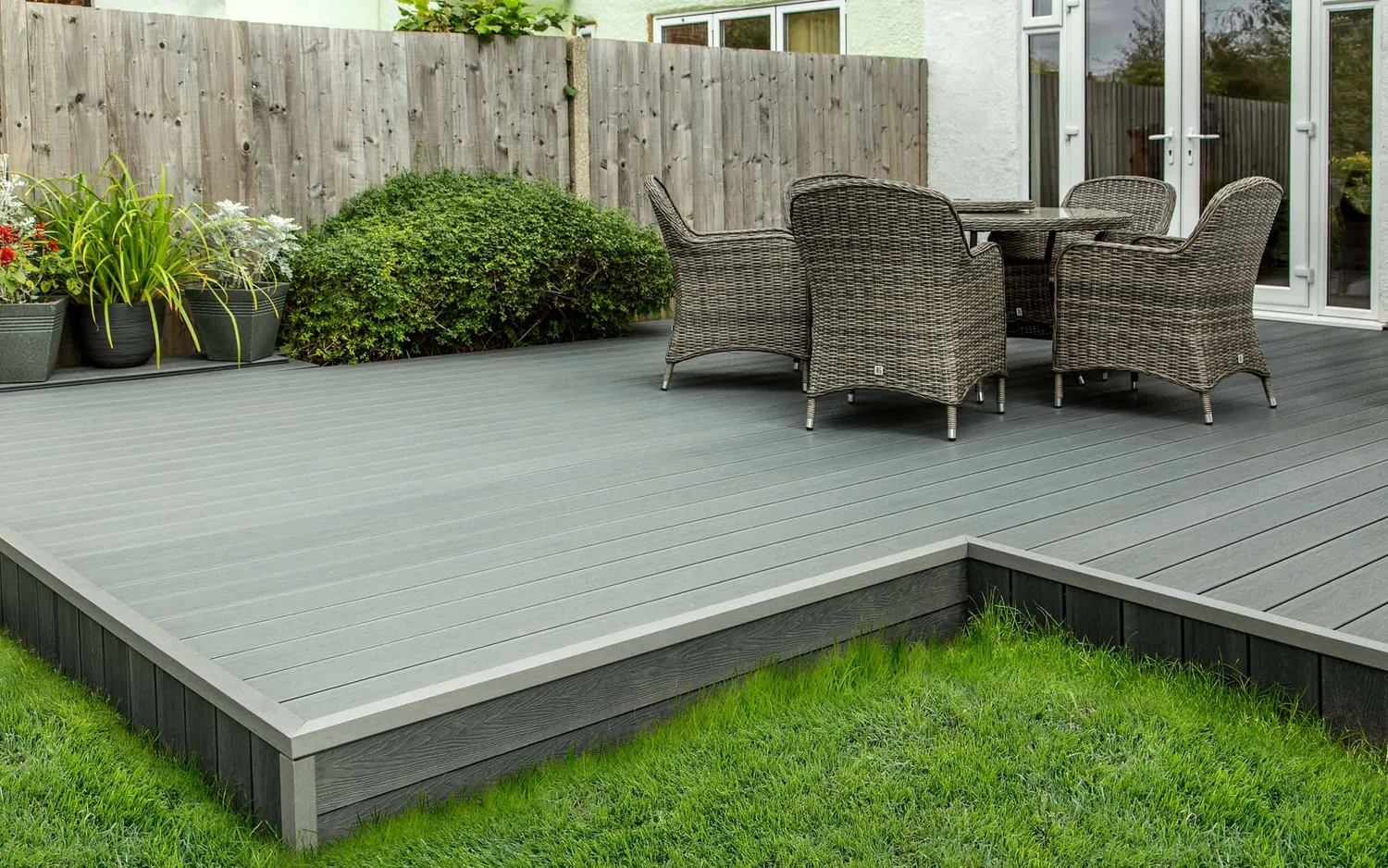
The end gap is the one most tied to temperature, so most brands key it to the air temperature on install day. A board cut on a hot afternoon is already near its longest, so it gets a smaller gap.
The butt-joint rules, by brand:
- TimberTech composite. Butt-joint gap at install: 3/16 inch at 32°F and below; 1/8 inch at 33–74°F; 1/32 inch at 75°F and up
- TimberTech AZEK PVC. Butt-joint gap at install: No gap: keep butt joints, splices, and miters tight
- Trex. Butt-joint gap at install: 1/8 inch above 40°F; 3/16 inch below 40°F
- Deckorators Surestone. Butt-joint gap at install: 1/16 inch above 32°F; 1/8 inch below 32°F
Look at where Melbourne lands on those tables. Every cold-weather cutoff is 32°F or 40°F, and TimberTech's middle band runs to 74°F. Most Melbourne installs fall in the warm band , which means the tightest butt gaps on each chart.
TimberTech says length changes are most significant during installation, and its PVC guidance says to keep boards as cool as possible while installing. In practice, that means stacking boards in the shade, not across a sunny driveway, and measuring gaps against the temperature the boards are actually at.
📌 Gap Numbers for a Melbourne Composite Deck
- TimberTech composite, 75°F and up: 1/32-inch butt gap, 1/8–3/16-inch side gap
- TimberTech AZEK PVC: tight butt joints, 1/8–1/4-inch side gap
- Trex, above 40°F: 1/8-inch butt gap, 3/16-inch side gap, 1/4 inch at walls
- Deckorators Surestone, above 32°F: 1/16-inch butt gap, 1/8-inch side gap
- Every brand: 16-inch joist spacing for standard boards, 12 inches on a diagonal
Hidden Fasteners: How the Clips Work
Grooved composite boards have a slot cut into each edge. A clip sits in the slot, screws down to the joist, and holds the board without a screw through its face. The result is a walking surface with no screw heads.
Each brand has its own system:
- TimberTech CONCEALoc. TimberTech says it was designed exclusively for TimberTech grooved boards, with one fastener and screw at each joist.
- Trex Hideaway. Trex's universal hidden fastener sets the gap: the guide says placing the fastener establishes the gap size, and fasteners must be used at every joist.
- Deckorators StealthLock. One clip at every joist along the board. Deckorators says the clip spaces the boards automatically, and each board is pinned at its center so the ends can expand and contract.
The clip is doing two jobs at once. It holds the board down, and it sets a consistent side gap the whole length of the run. That's why the brands want their own clips with their own boards.
Where Face Screws Still Belong
Hidden clips don't cover every board. Edges, stairs, and borders usually get a color-matched screw or a plug system instead.
Where each brand calls for something other than the hidden clip:
- First and last boards. TimberTech face-screws them with TOPLoc, or uses an L-Bracket or its Cortex plug system for a fastener-free look.
- Stairs. TimberTech says CONCEALoc may not be used on stairs. Trex calls for two color-matched screws per stringer on treads, installed flush, not countersunk.
- Square-edge boards and borders. Deckorators recommends color-matched screws placed 3/8 to 1 inch from the edges.
A picture-frame border is where this shows most. The border boards are often square-edged and face-fastened, while the field inside runs on hidden clips.
The Frame Under the Seams, and Your Warranty
Composite boards that move need solid support where they meet. The guides are direct about it:
- TimberTech: board ends must fall on a joist, and seams get double joists.
- TimberTech AZEK PVC: double joists or double blocking at butt joints when using CONCEALoc or FUSIONLoc.
- Deckorators StealthLock: always install a double joist at butt joints.
- Trex: a butt-joint clip over a single joist, or an added 2x4 nailer.
Joist spacing is the other half. All three brands list 16 inches on center for standard boards, with 12 inches on a diagonal. Our guide to capped composite vs. PVC decking covers how the two board types differ beyond the gaps.
Then there's the warranty. Trex says its warranty is conditioned on following its installation instructions and excludes improper gapping. TimberTech says non-Cortex screws or plugs nullify its warranty, and that gapping problems from non-TimberTech fasteners aren't covered.
That's why install details aren't small stuff. RWE installs TimberTech, AZEK, Deckorators, and Trex, and we're a certified pro on those brands. Here's what you get on a Right Way composite deck:
- The brand's own clips and gaps , set to that line's install guide
- Permit pulled and inspections handled , through the City of Melbourne or Brevard County depending on your address
- Built by our own crew in 1–2 weeks , once the permit is in hand
- Two-year workmanship warranty , separate from the board maker's warranty
See the full range of what we build on our wood and composite deck page.
A Composite Deck That Stays Flat Through a Melbourne Summer
Composite decking earns its keep on low upkeep, but only when the gaps and clips are set to the brand's guide on the day it goes down. Get those details right and the seams stay tight through August heat and cool January mornings.
Call 772-758-5372 or schedule a consultation at rightwayenclosures.com. One Team. One Timeline.
FAQs
How much gap do you leave between composite deck boards?
About 1/8 to 3/16 inch, set by the brand. TimberTech's composite guide calls for 1/8 to 3/16 inch side to side, Trex requires at least 3/16 inch, and Deckorators Surestone uses 1/8 inch above 32°F. In Melbourne we set the gap with the brand's own hidden clip so it stays even down the run.
Do composite deck boards need a gap at the ends?
Yes, for most lines. Composite expands along its length with heat, so TimberTech composite gets 1/32 inch at 75°F and up and Trex gets 1/8 inch above 40°F. TimberTech's AZEK PVC is the exception, with tight butt joints. We gap each Melbourne deck to its brand's temperature table.
Are hidden deck fasteners strong enough for Florida?
Yes, when they're the brand's own system at every joist. TimberTech CONCEALoc, Trex Hideaway, and Deckorators StealthLock each go in at every joist, and Trex says the clip sets the gap. On a Melbourne deck we use the matching clip for the board line, which also keeps the warranty intact.
Why is my composite deck buckling at the seams?
Most often the butt gaps were too tight for the temperature, or the board ends weren't supported. Composite grows lengthwise in Florida heat, and TimberTech and Deckorators call for double joists at butt seams. When we look at a Melbourne deck, we check gaps, joists, and fasteners against the brand's install guide.
Related services: Wood & Composite Decks · Above-Ground Pools · Consultation
Companion guide: Capped Composite vs. PVC Decking for a Vero Beach Deck