What Motorized Screen Install Day Actually Looks Like in Vero Beach
Start Your Transformation
From the crew pulling up to the remote landing in your hand: every step of a SunPro motorized screen install on a Vero Beach lanai, in the order you'll see it.
Quick Answer:
A motorized screen install day runs in a set order: arrival and protecting your lanai, a final measurement check, mounting the housing, setting the tracks, connecting the motor to power, programming the up and down limits and the remote, test cycles, then a walkthrough and cleanup. You'll want to be home for the start and for the walkthrough at the end.
Florida licensed & insured
SunPro motorized screens
3-year workmanship warranty
Indian River County permits
By the Right Way Enclosures team — Florida-licensed pool contractor (CPC1461491) and screen-enclosure specialty contractor (SCC131153510 / SCC131153892), serving Central and Eastern Coastal Florida. Last updated: 2026-10-08.
The Day, Step by Step
This guide is for Vero Beach homeowners who've already picked motorized screens and want to know what install day involves: arrival, protecting the space, the measurement check, the housing, tracks, the motor and its power, limits and remote, test cycles, the walkthrough, and cleanup. Still choosing a screen type? Our fixed vs. motorized screens guide for Vero Beach covers that.
The day runs in four blocks:
- Set-up: arrival, drop cloths, and a final measure.
- Structure: housing up, side tracks down.
- Power and programming: motor connected, limits set, remote paired.
- Close-out: test cycles, walkthrough, and a clean lanai.
Every screen in our motorized screen installation service is a SunPro screen, custom-made to widths up to 30 feet and heights up to 20 feet , per sunproproducts.com. Install day fits a made-to-measure product; nothing gets cut down on site.
Arrival, Protecting the Space, and the Final Measure
A proper install starts with a walk of each opening: which screen goes where, where the remote lives, and where power comes from. Then the lanai gets protected:
- Floors covered. Drop cloths go down on pavers, tile, or the pool deck under each opening.
- Furniture moved back from the work zone.
- Pool side covered. On a pool lanai, nothing should end up in the water.
Next comes the final measure. The opening gets checked against the ordered dimensions before anything is drilled: width top and bottom, height both sides, and level at the header and slab. Most lanai slabs slope slightly for drainage, and the tracks and bottom bar have to account for it.
If the opening needs structural work first, our guide to adding motorized screens to an existing lanai covers it.
Mounting the Housing and Setting the Tracks
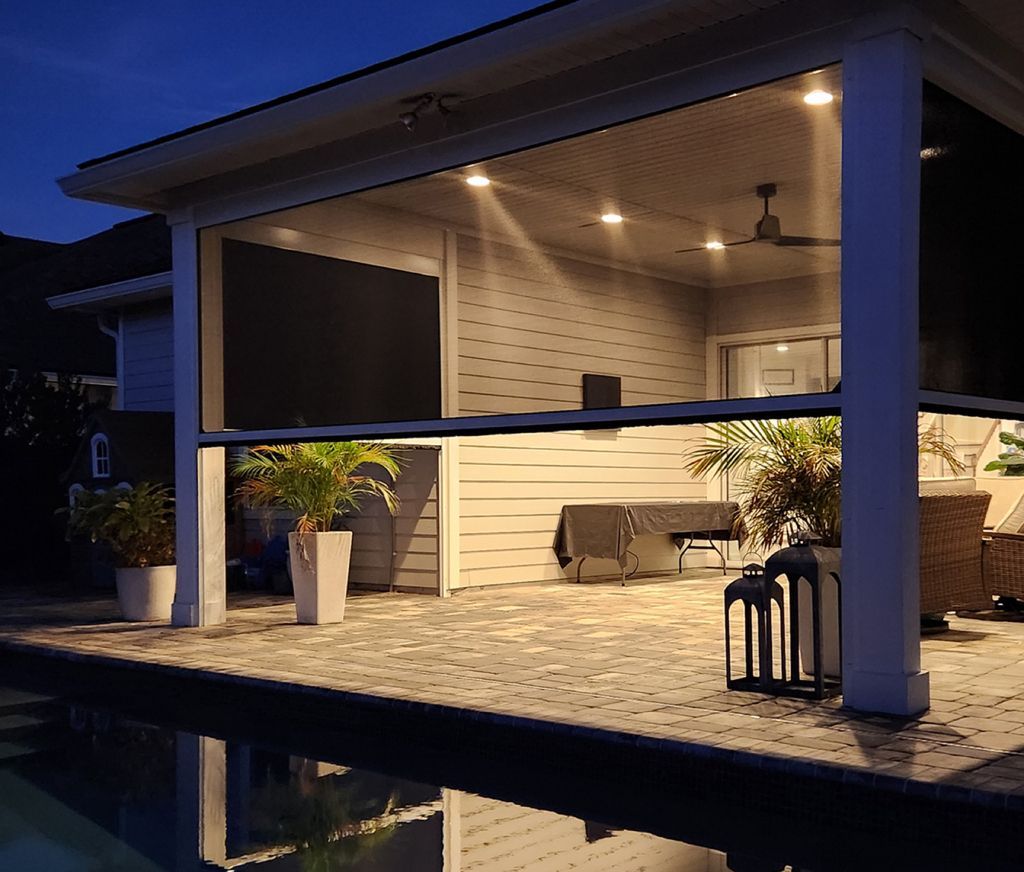
The housing is the box at the top of the opening that holds the rolled-up screen and the motor. SunPro describes it as a powder-coated, anti-corrosion, integrated cassette . That finish matters most on the barrier island, where Riomar, Central Beach, and Castaway Cove lanais take salt air off the ocean along A1A.
What happens at this stage:
- The housing gets mounted and leveled, because a crooked housing rolls the screen unevenly.
- The side tracks go on. SunPro offers a traditional track for retrofitting existing openings and a recessed track for custom built-ins .
- The tracks get plumbed so the screen's edges ride straight from top to bottom.
SunPro's Severe Weather Screens add a self-adjusting track and optional retention pins . Track and fabric are settled before install day; see our screen fabric guide and our post on motorized screens for afternoon shade.
The Motor and Its Power Hookup
SunPro screens run on Dooya and Somfy® motors , per SunPro. We install two setups, and the difference shows up on install day:
- Hardwired. The motor is wired to power at the housing, no cord showing. That power has to be run by a licensed electrician and permitted where the jurisdiction requires it.
- Plug-in. The motor plugs into an outlet near the housing.
In the City of Vero Beach and unincorporated Indian River County, permits run through the Indian River County Building Division at 1801 27th Street , which enforces the Florida Building Code, electrical provisions included. Indian River Shores and Sebastian permit separately.
📌 Before Install Day: Your Vero Beach Checklist
- Clear furniture, plants, and grills back from every opening
- Know where your breaker panel is
- Decide where the remote will live day to day
- Have HOA approval in hand if you're in one
- Gated community? Put the crew on the gate list
- Keep pets inside while the crew works
Limits, the Remote, and the Test Cycles
A motorized screen has to know where to stop. Setting the limits tells the motor where "fully up" and "fully down" are:
- Upper limit: the screen stops tucked into the housing, not straining against it.
- Lower limit: the bottom bar meets the floor and closes the gap without bunching the fabric.
- Remote pairing: SunPro lists a wireless remote , plus voice activation through smart devices .
Then come the test cycles: each screen runs up and down several times while the fabric, motor, and bottom bar get checked. Every screen gets its own test. SunPro offers an HD 2.5 bottom bar it says is 2.5 times heavier, with 68% less horizontal deflection .
Walkthrough, Handover, and Cleanup
The day ends with you, the remote, and every screen. The walkthrough covers:
- Running each screen yourself with the remote, up, down, and stopped partway.
- Which button runs which screen , if you have more than one.
- When to roll them up. SunPro says its solar mesh can block up to 85% of the wind and rain in the screened area. That's comfort, not a storm rating.
- Care basics. Our motorized screen maintenance guide covers cleaning.
Then the paperwork. SunPro covers hardware for life, fabric and mesh for up to 15 years, and motor and controls for 5 years . Right Way adds a 3-year workmanship warranty on every screen we install.
Cleanup comes last: drop cloths up, drill dust vacuumed, packaging hauled off, furniture back. For the bigger picture, see how a screen project runs from consultation to completion.
FAQs
Do I need to be home when my motorized screens are installed?
Yes, at least at the start and the end. At the start you confirm which screen goes on which opening and where power comes from. At the end you run every screen with the remote. In gated Vero Beach communities like Grand Harbor, add the crew to the gate list. Right Way handles the whole install under one contract.
Should I clear off my lanai before the screen installers come?
Yes. Move furniture, potted plants, and grills a few feet back from every opening the night before. Floors and pool decks still get drop cloths, but a clear lanai means less shuffling and faster drilling. On a Riomar or Central Beach lanai, that includes cushions. Right Way installs SunPro screens across Vero Beach and Indian River County.
Can I use my motorized screens the same day they go in?
Yes, once the motor has power, the limits are set, and the test cycles pass. A hardwired motor needs its circuit in place first, and in Vero Beach that work is permitted through the Indian River County Building Division where required. Right Way installs hardwired and plug-in SunPro motors, so power gets planned up front.
Can I control SunPro motorized screens with my voice?
Yes. SunPro lists voice activation through smart devices alongside its wireless remote. The remote gets paired during programming on install day, so it works before the crew leaves your Vero Beach lanai. SunPro backs motors and controls for 5 years. Right Way adds a 3-year workmanship warranty on every screen we install.
SunPro Screens, Installed Right in Vero Beach
You already paid for the lanai. Motorized screens let you use it in July and January without the bugs or the glare. We install SunPro screens across Vero Beach, Sebastian, and Indian River County under one contract.
Call 772-758-5372 or schedule a consultation at rightwayenclosures.com. One team. One design. One timeline.
Related services: Motorized Screen Installation · Lanai Installation and Repair · Consultation