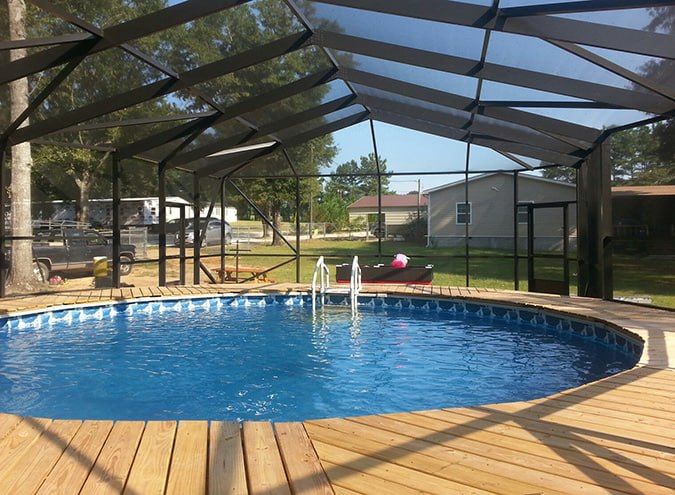
Pool and Screen Enclosure at the Same Time, or Build the Cage Later?
Start Your Transformation
The sequencing decision for Palm Bay homeowners planning a fiberglass pool and a screen enclosure — and what the order actually costs you
Quick Answer
Build both at once. Once the enclosure is standing, you can't get an excavator, a crane, or a dirt truck into the pool area without taking panels back out — and the enclosure footer has to be planned before the paver deck is laid, not after. Phasing is a legitimate choice for budget reasons, but the sequence has to be designed in from day one.
By the Right Way Enclosures team — Florida-licensed pool contractor (CPC1461491) and screen-enclosure specialty contractor (SCC131153510 / SCC131153892), serving Central and Eastern Coastal Florida. Last updated: 2026-08-06.
The Short Version: One Design, One Trip
If you know you want a screen enclosure eventually, design it with the pool. Not because it's a package deal — because the pool deck, the equipment pad, and the enclosure footer are one structural conversation, and splitting them into two conversations two years apart is how people end up demolishing work they already paid for.
Our fiberglass Retail Packages run $55,000 for the Neblina Grande (8' × 16') up to $92,500 for the Colombian Cove Resort (12' × 33') with its built-in spa , and every package already includes a 3-foot paver border, full machine excavation, structural engineering, municipal permits, and inspection coordination. The enclosure is a separate scope, quoted by footprint and roof style.
What "designed together" actually buys you:
- One site plan that places the pool, the deck edge, the enclosure footprint, and the equipment pad in relation to each other.
- One mobilization. The excavator, the mason, and the enclosure crew work a continuous schedule instead of two separate disruptions.
- One point of contact for the whole outdoor project, instead of a pool builder and a cage company pointing at each other.
Financing is available through Lyon Financial and Foundation Finance Company for qualified homeowners, which is often what makes the combined build possible in one phase instead of two.
Access Is the Real Constraint
This is the part homeowners underestimate. A fiberglass shell arrives on a truck and goes in with a crane or a large excavator. That equipment needs a clear path from the street to the hole.
An existing screen enclosure blocks that path completely. It is not a matter of squeezing past it:
- Panels and beams have to come out to open a gap wide enough for equipment, then go back in and be re-screened.
- The gap has to be wide enough for the shell itself , not just the machine — a 14-foot-wide shell doesn't thread through a 10-foot opening.
- Side-yard access on a Port Malabar lot is often the only route , and the enclosure typically sits right across it.
- Re-screening and re-sealing after the fact is labor you're paying for twice.
Retrofitting an enclosure onto a finished pool is absolutely something we do — it's just a different job with different constraints, and the cost of the access work is real.
Thinking about a pool and a cage in Palm Bay? Let's design the whole thing on one site plan before anything gets dug — call (772) 758-5372 for a consultation.
The Footer Decision Comes Before the Deck
A screen enclosure doesn't sit on grass. It anchors to a concrete footer or a deck slab engineered to take the uplift and lateral load, and in Brevard that load is not trivial — we engineer to the 150 mph FBC wind-load standard across our service area.
Here's why the order matters. If the paver deck goes down first without the enclosure in the plan, one of two things happens later:
- You cut into finished hardscape to pour the footer, then patch the pavers back — and a patch never quite matches a field laid in one pass.
- You shrink the enclosure to land on whatever structure already exists, which usually means a smaller footprint than the one you actually wanted.
When both are planned together, our licensed mason sets the deck to the enclosure line from the start. The footer goes in as part of the deck work, the paver field runs uninterrupted to the frame, and there's no patch.
The hardware matters here too. Stainless steel fasteners are the standard on every Right Way enclosure — galvanized rusts out in Brevard humidity, and the fasteners are the last thing you want to be replacing on a structure engineered to stand through a storm.
Two Permits, One Schedule
The pool and the enclosure are separate trades, separate engineering submittals, and separate inspections. That's true whether one company does both or two companies do.
What changes is who's holding the calendar:
- Pool permit — the pool structure, the barrier, the electrical, and the equipment.
- Enclosure permit — the aluminum structure, its engineering, and its attachment to the deck or footer.
- Inspections in sequence — the enclosure can't be finalled against work that hasn't passed its own inspection yet.
As a single-source partner we submit both, sequence them, and coordinate the inspections. When two separate companies are involved, that coordination becomes your job — and it's the single most common way an outdoor project slips a season.
For the pool itself, our fiberglass claim is straightforward: ground-breaking to first swim in under 30 days. That clock is install time and starts after the permit is approved. The City of Palm Bay's review window runs at the city's pace, so budget the permit period on top of the build.
If you're already comparing quotes, ask each one who's pulling the enclosure permit and who's coordinating the inspections. Call (772) 758-5372 and we'll walk you through our version.
When Phasing Actually Makes Sense
Building it all at once isn't always the right call, and we'll say so. Phasing is genuinely reasonable in a few situations:
- The budget only supports the pool this year. A pool you can afford now beats a combined project you defer for three years.
- You're not sure you want a cage. Some Palm Bay homeowners live with an open poolscape a season, decide the bugs and the oak litter aren't worth enclosing, and never build it.
- You want a bigger enclosure than the current deck supports and would rather expand the hardscape later as one project.
If you're phasing, do this one thing: have the enclosure designed and footered during the pool build even if the frame doesn't go up. The footer and the deck layout cost very little to include now and a great deal to retrofit. It's the difference between adding a cage later and rebuilding a deck later.
We cover the retrofit path in detail in our guide to building a pool screen enclosure, and the enclosure build process from consultation to completion walks through what each stage looks like.
📌 Decide These Six Things Before Anything Gets Dug
- ✅ Enclosure footprint — where the frame lands, marked on the site plan
- ✅ Roof style — mansard, gable, or flat pan changes the structure and the price
- ✅ Footer type — poured footer or engineered deck slab edge
- ✅ Deck material — travertine, porcelain, or paver, laid to the frame line
- ✅ Equipment pad location — inside or outside the enclosure
- ✅ Door placement and screen mesh spec before the frame is fabricated
Planning It in Palm Bay
Palm Bay's Port Malabar grid gives most homeowners something genuinely valuable: room. Quarter-acre-and-up platted lots off Emerson Drive, Minton Road, and the Malabar Road corridor generally have space for a full poolscape and an enclosure without fighting the setbacks.
A few local realities worth planning around:
- Side-yard access varies a lot. Homes on the tighter interior blocks may have only one workable equipment route, which makes the build-order question decisive.
- Bug pressure near Turkey Creek and the lagoon side is real , and it drives more Palm Bay enclosure decisions than storm protection does. Mesh spec matters — we break it down in our Palm Bay screen mesh guide.
- Confirm setbacks with the City of Palm Bay building division for your specific lot before you finalize a footprint. Platted-lot dimensions vary across the grid.
The whole point of doing it together is that you get one design, one crew, and one timeline — and nobody hands you a phone number for a different company when something needs fixing.
FAQs
Can you add a screen enclosure to a fiberglass pool after it's built?
Yes, and we do it regularly. The catch is access — the enclosure has to be designed around a finished deck rather than the other way around, and the footer may require cutting into existing hardscape. Right Way handles retrofits, but we'll always show you what building both together would have saved.
Does the pool deck have to be finished before the enclosure goes up?
Yes, in almost every case. The enclosure anchors to the deck slab or a poured footer, so that concrete work has to be complete and cured first. On a combined Palm Bay build our mason sets the deck to the enclosure line, so the frame lands on structure that was engineered for it from the start.
How much wind can a Palm Bay pool enclosure take?
Right Way engineers every screen enclosure to the 150 mph FBC wind-load standard across our service area, not just on barrier-island lots. Combined with stainless steel hardware, that's the build spec regardless of where in Brevard you are. Your engineering submittal goes to the city with the permit application.
Do I need two separate permits for a pool and a screen enclosure?
Yes. The pool and the enclosure are separate trades with separate engineering and separate inspections, even on a single contract. The difference with a single-source build is that we submit and sequence both, so the inspection order works out instead of leaving you to chase two companies' schedules.
One Design, One Timeline
A pool and an enclosure aren't two projects that happen to share a yard. They're one outdoor living space with a structure over it, and the decisions that make it work — footer, deck line, access route, equipment placement — all get made in the first week.
We build the pool, lay the hardscape with our own licensed mason, and put up the enclosure with our own crew. One contract, one schedule, one number to call.
Call (772) 758-5372 or schedule a consultation at rightwayenclosures.com.
One team. One design. One timeline.
Related services: Fiberglass Pools · Pool Screen Enclosures · Pavers & Hardscapes · Consultation
Companion guides: Pool Screen Enclosure Timeline in Palm Bay · Pool Screen Enclosure Mesh in Palm Bay