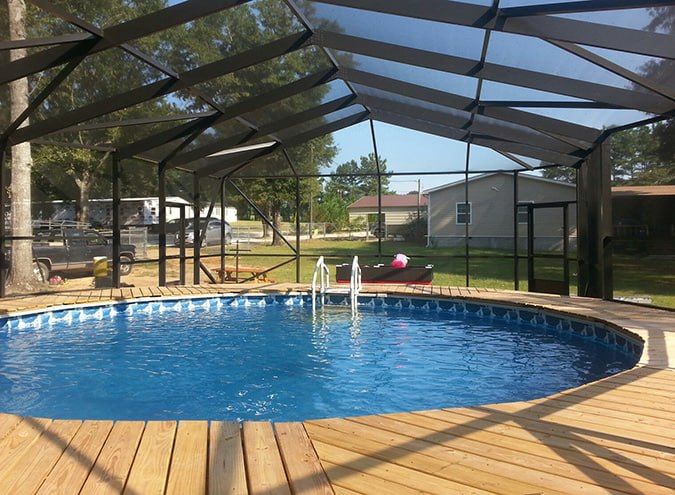
Build a Deck Around Your Above Ground Pool and the Barrier Rules Change
Start Your Transformation
Why a deck cancels the pool-wall exemption in Volusia County — and the code-compliant ways to put the barrier back before your inspector shows up.
Quick Answer
In Volusia County, an above ground pool wall at least 48 inches above grade can act as its own barrier — but the moment you build a deck up to that wall, the wall stops keeping anyone out and the barrier requirement lands on the deck instead. Fixing it costs almost nothing if it's designed in from day one, and a lot if it's discovered at final inspection.
Florida licensed & insured
Volusia County permit-pulling
In-house pool & deck crews
Resin-coated, saltwater-ready
By the Right Way Enclosures team — Florida-licensed pool contractor (CPC1461491) and screen-enclosure specialty contractor (SCC131153510 / SCC131153892), serving Central and Eastern Coastal Florida. Last updated: 2026-08-11.
Why the Pool Wall Stops Being the Fence
Most families buying an above ground pool in Volusia County get a pleasant surprise early on: you may not need a fence at all.
Florida Building Code Section 454.2.17 lets an above ground pool wall standing at least 48 inches above grade serve as the barrier itself, as long as the ladder or steps can be locked, secured, or removed. That's the whole reason above ground pools clear the safety requirement so easily.
Then the deck gets added, and the logic breaks:
- The wall only worked because nobody could climb it. A deck is a permanent way over it.
- A deck is a walking surface, not a ladder. You can't lock it, secure it, or take it away at night.
- The barrier requirement doesn't disappear — it just moves to the deck.
- Your inspector reads it the same way. This is not an interpretation call; it's the plain reading.
- It applies to partial decks too. A small entry landing at pool height counts.
That's the single most expensive surprise in the above ground world, and it's entirely avoidable. It only bites people who buy the pool from one place, hire a deck guy separately, and let the two decisions happen six weeks apart.
Who Reviews Your Deck — the County or Your City?
"Volusia County" on your mail doesn't tell you which building department reviews your deck, and that trips people up before anything else does.
Unincorporated Volusia County permits go through the county's building division. Incorporated cities run their own — Deltona, Daytona Beach, DeLand, Ormond Beach, Port Orange, New Smyrna Beach and Edgewater each have their own building department and their own submittal process.
What that means for your project:
- Confirm jurisdiction by address , not by mailing city, before anything gets filed.
- The pool and the deck are separate scopes , even when one contractor does both.
- A raised deck is structural work — it gets engineering and a framing inspection.
- We build to a 150 mph wind-load standard across the service area, so the engineering doesn't change lot to lot.
- Permit windows belong to the reviewing office , not to us. Ask for the current window in your specific jurisdiction.
If you haven't started the pool permit yet, our step-by-step guide to above ground pool permits in Deltona covers the pool side of the filing.
Three Ways to Put the Barrier Back
Florida's Residential Swimming Pool Safety Act — Chapter 515 of the Florida Statutes — requires at least one approved safety feature on a residential pool. Once a deck is in the picture, these are the routes families here actually take.
1. A barrier around the whole pool-and-deck area. A compliant fence at least four feet high, with no gap a four-inch sphere can pass through, and a self-closing, self-latching gate. This is the most common answer on a larger lot with room to run fence.
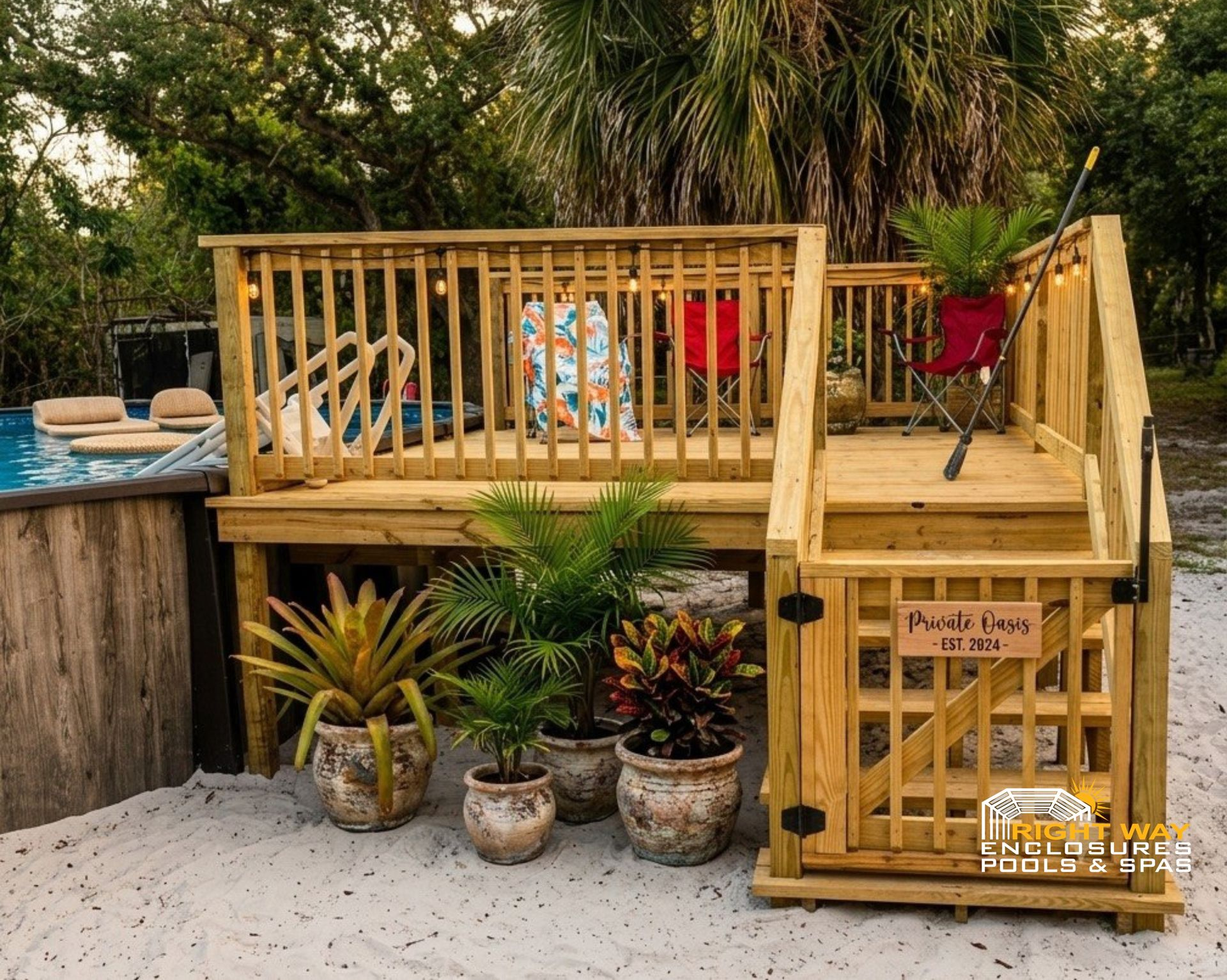
2. A gated stair access on the deck. Instead of fencing the yard, you gate the way up. The deck's guard becomes the barrier and the stairs get a self-closing, self-latching gate, so the deck surface is only reachable through a gate that shuts by itself.
3. Removable or lockable stairs. On some deck designs the stair section itself lifts out or locks, which keeps the original "access can be secured" logic intact. Whether your building department accepts it depends on the design, so this one gets confirmed at plan review rather than assumed.
A screen enclosure over the pool and deck is a fourth route that some Volusia families take for the bug and debris side anyway — our Brevard County barrier code guide walks through the full code spec sheet those barriers are measured against.
The Stairs Are the Whole Problem
Everything above comes down to one detail, so it's worth its own section: the stairs are where the barrier lives or dies.
A gate at the bottom of the stairs and a gate at the top are not the same thing, and neither is a latch you have to remember to close. Self-closing and self-latching means the hardware does the work when a nine-year-old runs through it.
The details that get flagged at inspection:
- Latch height. Latch hardware has a required mounting position so a small child can't reach it.
- Gate swing. Barrier gates open away from the pool, not toward it.
- Guard height on the deck. A walking surface more than 30 inches above grade generally requires a guard — confirm the current requirement with your building department.
- Gaps under and between. The four-inch-sphere rule applies to the deck guard the same way it applies to a fence.
- Anything climbable next to it. A cooler, a planter, or a storage box beside the guard is a step stool.
That last one isn't code, it's experience. We've watched more than one family pass inspection and then create the exact problem the barrier was there to prevent by parking patio furniture against the rail.
Design the Deck and the Barrier Together
Here's the money part. Barrier hardware designed in during the deck drawings is a rounding error. Barrier hardware retrofitted into a finished deck means cutting, re-framing, and re-inspection.
A wood deck typically adds $5,000 to $10,000 to an above-ground pool project. Combined pool-and-deck projects run above $15,000, and financing is available through our financing partners for qualified homeowners.
📌 Decide These Before the Deck Is Framed
- Which barrier route you're taking — perimeter fence, gated stairs, or removable stairs
- Where the stairs land, and which way the gate swings
- Guard height and gap spacing on every deck edge
- Whether the deck covers the equipment pad (it can't block pump service)
- Grade and drainage under and around the deck
- Which building department is reviewing it
Two of those deserve a note. The equipment pad has to stay reachable — a deck built over the pump is a service and inspection problem later. And the ground under a raised deck still sheds water, so grading matters; the same drainage principles that keep a patio from puddling apply under a pool deck.
If you're finishing the ground-level area outside the deck as well, our guide to pool deck finishes and how they hold up in Florida heat is worth reading before you pick a surface.
What This Looks Like on a Deltona or Daytona Lot
Volusia isn't one kind of lot, and the barrier route that makes sense changes with the yard.
Deltona. The Deltona Lakes platted lots off Howland, Providence and Saxon are mostly regular rectangles with real side-yard room. There's usually space to run a perimeter fence, which is why the full-yard barrier is the common answer here — and it doubles as the dog fence a lot of families wanted anyway.
Daytona Beach and the beachside. Lots run tighter and older east of the Halifax River, and a perimeter fence often eats the whole usable yard. The gated-stair route tends to win, because it protects the pool without giving up the ground around it.
DeLand and west Volusia. Larger and more rural parcels, more unincorporated addresses, and more room to place the pool away from the house — which changes where the stairs want to land and often simplifies the whole barrier question.
The point isn't which one is right. It's that the barrier decision belongs in the site walk, before anybody orders lumber.
One Crew, One Permit, One Inspection
The reason this goes sideways for so many families is that the pool and the deck get bought from two different people. The pool company says the deck guy handles the barrier. The deck guy says the pool company set the height. The inspector says no.
We do the pad, the pool, the electrical, the deck and the barrier as one job, on one contract, with one crew — so the deck height, the stair placement, and the gate are designed together the first time. On timing: from delivery to first swim in under 7 days on the pool, with the permit window on top, because that clock belongs to the reviewing office and not to us.
Call 772-758-5372 or schedule a consultation at rightwayenclosures.com. One team. One design. One timeline.
FAQs
Does a deck around my above-ground pool need a permit in Volusia County?
Yes. A raised deck is structural work requiring engineering, plan review and a framing inspection, filed with Volusia County's building division or with your city if you're inside Deltona, Daytona Beach, DeLand or another incorporated municipality. Right Way pulls the pool and deck permits together as one scope.
Why does my pool need a fence once I add a deck?
Because the deck defeats the wall. Florida Building Code Section 454.2.17 only lets a 48-inch pool wall serve as the barrier when access can be secured, and a permanent deck is unsecurable access. The barrier requirement shifts to the deck, usually as a self-closing gate at the stairs.
Can I use a gate on the deck stairs instead of fencing my whole yard?
Yes, and on tighter Daytona Beach lots it is usually the better answer. The deck guard becomes the barrier and the stairs get a self-closing, self-latching gate that swings away from the pool. Your building department confirms the design at plan review, which we handle as part of the job.
How much does a deck add to an above-ground pool in Volusia County?
Roughly $5,000 to $10,000 on top of the pool, depending on size, material and layout. Pricing is uniform across Deltona, Daytona Beach, DeLand and every market we serve. Combined projects over $15,000 qualify for financing through our lending partners.
Related services: Above-Ground Pools · Pool Screen Enclosures · Consultation
Companion guides: Building a Deck Around an Above-Ground Pool in Palm Bay — deck materials, cost and structural permits · Above Ground Pool Timeline in Volusia County