Capped Composite vs. PVC Decking: What's Actually Different for a Vero Beach Deck
Start Your Transformation
Both get sold as "low-maintenance," but one has wood fiber in the core and one doesn't. Here's what that changes for a deck near the Indian River Lagoon.
Quick Answer:
The difference is the core. Capped composite is recycled wood fiber and plastic wrapped in a polymer shell, while PVC decking is all polymer with no wood in it at all. That makes PVC lighter and less dependent on its cap to keep water out. Capped composite comes in a wider range of lines from all three brands we install. For a Vero Beach deck, shade, water exposure, and the specific product line matter more than the category name.
In this article
- Two Kinds of Board, Three Brands
- What's Actually Inside the Board
- Water, Shade, and Mold Near the Lagoon
- Weight, Movement, and the Frame Underneath
- Warranties: Read the Product Line, Not the Brand
- Which One Fits a Vero Beach Deck
- FAQs
Florida licensed & insured
Certified TimberTech & Trex pro
Indian River County permits
One crew, one contract
By the Right Way Enclosures team — Florida-licensed pool contractor (CPC1461491), screen-enclosure specialty contractor (SCC131153510 / SCC131153892), and state-certified carpentry contractor (SCC131154682), serving Central and Eastern Coastal Florida. Last updated: 2026-10-05.
Two Kinds of Board, Three Brands
Walk into a showroom and "composite" gets used for everything that isn't wood. That's not quite right. There are two different products on that rack, and they're built differently.
Here's the split:
- Capped composite. A core of recycled wood fiber and plastic, wrapped in a hard polymer cap. Most of what's sold as "composite" is this.
- PVC (cellular PVC). A board made entirely of polymer. No wood fiber anywhere in it.
The three brands we install sit differently across that line:
- TimberTech makes both. Its composite collections are capped boards; its AZEK line, now sold as TimberTech Advanced PVC, is the PVC side.
- Trex is a capped composite brand. Trex does make a PVC board called Refuge, but Trex says it's available only in select regions.
- Deckorators sells capped wood-fiber composite and a third option it calls Surestone, which isn't PVC and isn't wood-filled.
If you're still deciding between wood and any of these, start with our companion guide on wood vs. composite decking for a Florida pool deck. It covers heat underfoot and fade, so we won't repeat that here.
What's Actually Inside the Board
The core is the whole story. Each brand publishes what goes into its boards, and the differences are real.
What each manufacturer says:
- TimberTech composite: recycled wood and plastic under a polymer cap, up to 85% recycled. Four collections are capped on all four sides (Legacy, Reserve, Terrain+, Terrain). Three are capped on three sides (Prime+, Prime, Premier).
- TimberTech Advanced PVC: "100% polymers," with no wood or organic fillers in the core or the cap. Collections include Vintage, Landmark, Harvest+, and Harvest.
- Trex: 95% recycled materials, reclaimed sawdust and recycled plastic film, with a shell that wraps three sides of the board.
- Deckorators Surestone (Voyage and Summit): plastic polymers and minerals, with zero organic material, per Deckorators.
- Deckorators Vista: recycled plastic and sawdust, capped on three sides including through the groove.
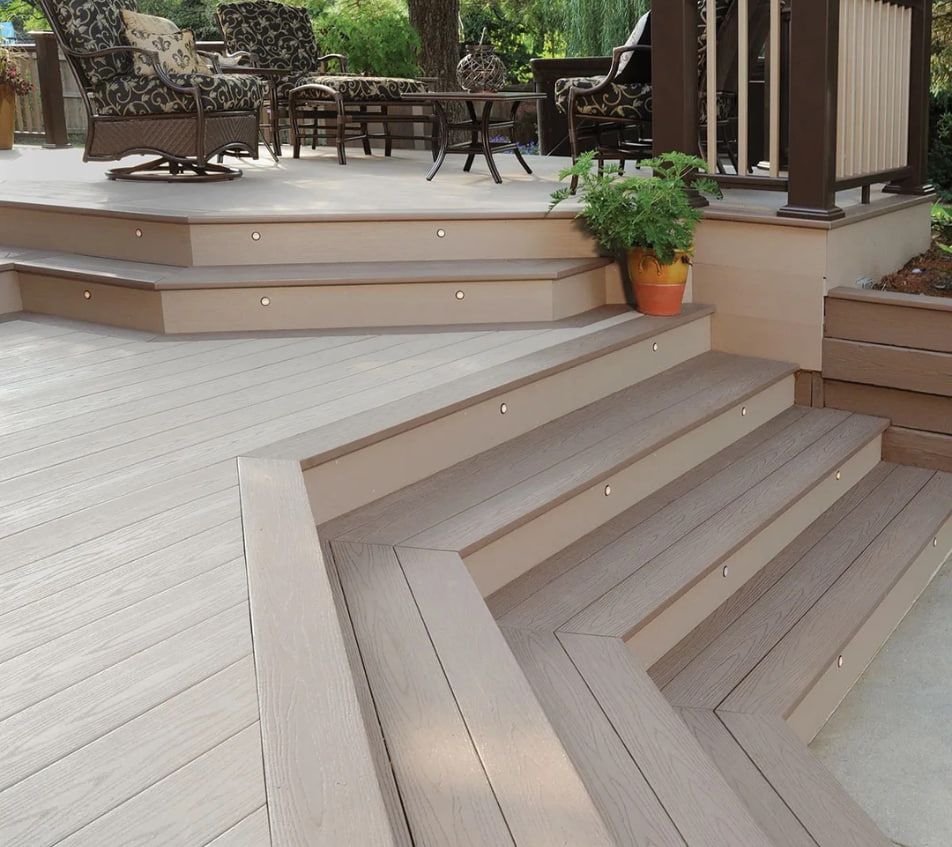
Notice the three-sided versus four-sided detail. On a three-sided board, the underside has no cap. That matters more on a low deck than a high one.
Water, Shade, and Mold Near the Lagoon
Vero Beach decks live in damp air. A house near the Indian River Lagoon, or one on the barrier island off A1A, sees humidity that never fully lets up. Add a shaded lot and the underside of a deck may stay wet for days.
That's where core material shows up. What the brands say about moisture:
- TimberTech says PVC avoids the moisture invasion that can lead to mold, mildew, and rot.
- Deckorators says wood fibers can absorb moisture and contribute to swelling. It says Surestone absorbs virtually no moisture.
- Trex says its shell provides resistance to mold.
Put plainly, a capped composite keeps water out with its cap. PVC and Surestone keep it out because the core has nothing to absorb it.
One more detail from TimberTech: its three-sided capped collections don't include its Mold Guard technology. On a shaded deck, that's worth knowing before you pick a line.
Mold on any board's surface is still a cleaning job. Both Trex and Deckorators exclude surface mold from their warranties if it isn't cleaned within a week of showing up.
Weight, Movement, and the Frame Underneath
The board you choose also changes how the deck goes together. Most of this is invisible once it's built, but it's on the install sheet.
Where the categories differ:
- Weight. TimberTech says its PVC is lighter than wood or composite. Deckorators says Voyage is 35% lighter than traditional composite boards.
- End gaps. Install guides handle temperature differently. TimberTech's PVC guide calls for tight butt joints regardless of temperature, while its composite guide sets gaps by install temperature.
- Joist spacing. For standard boards, TimberTech, Trex, and Deckorators all list 16 inches on center, with tighter spacing when boards run diagonally.
The frame under any of these boards is wood, and it's what carries the deck. Our guide on pool deck footings and framing covers what holds it up.
Warranties: Read the Product Line, Not the Brand
People shop by brand. Warranties are written by product line. Two boards from the same company can carry very different coverage.
Published residential warranty terms:
- TimberTech: 30-year product warranty on its four-sided composite collections, 25 years on Prime+, Prime, and Premier, and a lifetime limited product warranty on Advanced PVC.
- Trex: 25 to 50 years depending on the line. Enhance carries 25, Select 35, and Transcend and Signature 50.
- Deckorators: 50-year structural warranty on Voyage, and 25 years on Summit, Vista, Venture, and Altitude.
There's fine print to know. Deckorators says installation must strictly comply with its instructions. Trex's warranty excludes improper installation and gapping, and acts of God including hurricanes and flooding.
That's where the installer matters. Right Way is a certified pro on TimberTech, AZEK, Deckorators, and Trex, so every line goes down by the manufacturer's install guide. Our own two-year workmanship warranty sits on top, separate from the board maker's.
Which One Fits a Vero Beach Deck
There's no single winner. The right board depends on where the deck sits and what it's up against.
📌 Picking Between Capped Composite and PVC
- Low deck, shaded lot, little airflow: lean toward PVC or Surestone
- Sunny, open site with good airflow: a four-sided capped composite does the job
- Weight is a factor: PVC or Deckorators Voyage
- Widest color and texture range: capped composite, across all three brands
- Any board: confirm the warranty for that exact line, not the brand
If you're comparing a deck to a ground-level surface, our look at cool decking options for a pool deck covers the concrete side. And if an old cracked slab is the reason you're shopping, see our guide to concrete repair vs. replacement in Vero Beach first.
What you get with Right Way:
- Certified pro on TimberTech, AZEK, Deckorators, and Trex
- Permit pulled through the Indian River County Building Division, which serves Vero Beach too
- Built by our own crew in 1–2 weeks once the permit is in hand
- Two-year workmanship warranty on the deck
See what we build on our deck installation page, or pair the deck with one of our above-ground pools.
FAQs
Is PVC decking better than composite in Florida?
No, not across the board. PVC has no wood in its core, so it doesn't depend on a cap to stay dry, which helps on shaded, damp Vero Beach lots. Capped composite offers more lines and looks from TimberTech, Trex, and Deckorators. We match the board to your site after walking it.
Does Trex make PVC decking?
Yes, but you likely won't see it here. Trex says its PVC board, Refuge, is sold only in select regions. Trex's main residential lines, Signature, Transcend, Select, and Enhance, are capped composite. If you want PVC, TimberTech Advanced PVC is the line we'd show you, and we're certified on both.
Is PVC decking lighter than composite decking?
Yes. TimberTech says its PVC is lighter than wood or composite. Deckorators says its mineral-based Voyage board is 35% lighter than traditional composite. Lighter boards are easier to handle on a raised deck. The frame still carries the load, so we size it for the board and span you pick.
Does capped composite absorb water?
The cap doesn't, but the core can. Deckorators notes that wood fibers can absorb moisture and swell, which is why the cap matters. Trex and some TimberTech lines cap three sides, leaving the underside open. On a low, shaded Vero Beach deck, we often point homeowners to four-sided caps or PVC.
One Crew From the Frame to the Last Board
The board you pick decides how the deck looks for the next couple of decades. The crew who builds it decides whether it's installed the way the manufacturer's warranty expects.
We handle Vero Beach decks start to finish: the layout, the permit, the frame, the boards, and the inspections. One crew, one contract, and a straight answer on which board fits your yard.
Call 772-758-5372 or schedule a consultation at rightwayenclosures.com. One team. One design. One timeline.
Related services: Deck Installation · Above-Ground Pools · Consultation