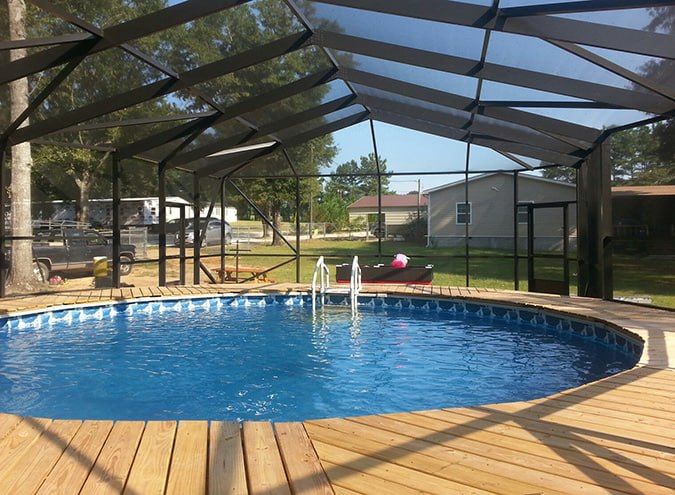
Above-Ground Pools in Daytona Beach: Sand, Salt Air, and the Water Table
Start Your Transformation
What your Volusia County lot actually has to handle — and why the water table that ruins in-ground budgets doesn't touch an above-ground pool.
Quick Answer
Yes — almost every Daytona Beach lot can take an above-ground pool, and the sandy soil and high water table that make in-ground builds expensive here barely register. An above-ground pool sits on a compacted pad on grade, so there's no excavation, no dewatering, and no hydrostatic pressure fighting the shell. Salt air is the one real variable, and a resin-coated structure handles it.
By the Right Way Enclosures team — Florida-licensed pool contractor (CPC1461491) and screen-enclosure specialty contractor (SCC131153510 / SCC131153892), serving Central and Eastern Coastal Florida. Last updated: 2026-07-23.
Can Your Daytona Beach Lot Take a Pool?
Most people asking this have already been handed an in-ground quote that made them put the phone down. A big piece of that number is what's under the grass.
Above-ground never goes under the grass. The pool sits on a pad we build on top of your yard, so the things Volusia throws at pool builders stop mattering.
Here's what actually decides whether your lot works:
- A reasonably flat area. We correct slope, but a yard that drops several feet across the footprint needs more pad work.
- Access for crew and material. Fenced Daytona lots off Nova Road and Clyde Morris Boulevard are usually fine; tight zero-lot-line yards need a walk-through first.
- Setback room. The pool and its barrier sit inside the setbacks your jurisdiction requires.
- A power source. The pump needs a dedicated circuit, run and inspected.
- Nothing buried under it. Septic tanks, drain fields, and easements are the real disqualifiers — common on older mainland lots.
Notice what isn't on that list: soil type, water table, distance from the ocean.
Volusia's Water Table Is the Real Story
Much of Volusia County sits on sand with a seasonal high water table. Dig a hole in a Daytona Beach backyard in a wet August and it starts filling itself in.
For an in-ground pool that's a real engineering problem. The excavation gets dewatered while the shell goes in, and the finished pool needs a hydrostatic relief valve so groundwater pressure doesn't float the shell when it's drained.
For an above-ground pool, none of that applies. No hole, no dewatering pump running for days, no hydrostatic pressure, no wet-season delay. The pool sits on grade and the groundwater stays where it is.
If you've been quoted an in-ground pool here and choked on the number, that's the piece worth understanding — a chunk of it is the ground itself.
Sandy Soil and the Pad Under Your Pool
Sand is a good base for an above-ground pool. It drains, it doesn't hold water against the structure, and it compacts predictably. What it won't do is stay level if somebody rakes it flat and drops a pool on it.
That's the difference between a professional install and the horror stories. A wall on an uncompacted sand pad settles unevenly, and once one side drops, it's fighting thousands of pounds of water at an angle it wasn't engineered for.
Our pad prep on a sandy Volusia lot:
- Strip the organics. Grass, roots, and topsoil come out — they decompose and leave voids.
- Cut to level, not fill to level. Where the yard allows, we cut the high side down instead of building the low side up.
- Compact in lifts. Mechanical compaction in layers, so the base doesn't settle after the water goes in.
- Set the base ring and bottom. A screeded surface with no stones under the liner.
- Check level twice before water. Once it's full, correcting it means draining it.
The same rule applies to whatever goes next to the pool — the base under a pool deck finish matters as much as the finish, and there are several deck surface options worth knowing before you pick one.
📌 What Makes a Daytona Beach Lot Above-Ground Ready
- Flat-ish area with working room around the pool
- Gate or side-yard access for crew and material
- Room inside your setbacks for the pool and its barrier
- Power available for a dedicated pump circuit
- No septic tank, drain field, or easement under the footprint
- Sandy soil and high groundwater are fine — that's an in-ground problem
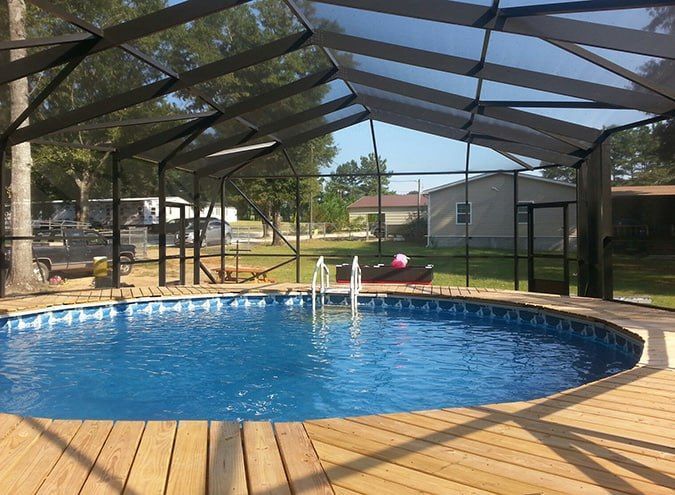
Salt Air: Beachside vs. Mainland Daytona
Here's where geography does matter. A house on the peninsula east of the Halifax River — A1A, Daytona Beach Shores, Ormond-by-the-Sea — lives in salt air year-round. A house out on the LPGA Boulevard corridor doesn't, at least not the same way.
Salt air is what eats big-box above-ground kits alive. Galvanized-steel walls rust from the inside of the panel where you can't see it, and by the time you can, the pool is done.
We use a resin-coated structure because of this. Resin doesn't rust. It's the direct answer to the question every beachside homeowner asks: how long is this really going to last a block from the ocean?
The same logic drives the water-treatment recommendation:
- We recommend a saltwater system over chlorine — softer on skin and eyes, less day-to-day fuss, no hauling chlorine into a hot garage.
- The structure is built for it. Resin-coated walls and heavy-duty, saltwater-ready hardware are the standard build, not an upgrade you ask for.
- Chlorine is still on the menu. We install both, and we'll tell you what each costs you in weekly time.
- Salt is not maintenance-free. The cell needs periodic cleaning and eventual replacement. Anyone who says otherwise is selling.
Worth saying plainly: we charge the same in Ormond Beach as we do in DeLand. No beachside surcharge, no salt-air adder. Same spec across the service area.
Permits: City of Daytona Beach vs. Volusia County
This trips up Volusia homeowners more than anything else, because "Daytona Beach" on your mail doesn't tell you who reviews your permit.
Inside the incorporated City of Daytona Beach, the city's building division handles it. In an unincorporated pocket — and there are plenty around the county — Volusia County building and zoning has it. Port Orange, Holly Hill, South Daytona, and Ormond Beach each run their own reviews.
Either way, a residential pool in Florida is a permitted job with an inspection at the end, and the barrier requirement under Florida's Residential Swimming Pool Safety Act (Chapter 515) is not optional. Your reviewer wants to see:
- The pool on a site plan, with setbacks and easements shown.
- The electrical scope for the pump circuit and bonding.
- How the barrier requirement is met — wall height, a removable or lockable ladder, self-closing gates, or a fence.
- Wind-load engineering where a deck or enclosure is in scope. We build to the 150 mph FBC standard service-area-wide.
We pull the permit, schedule the inspection, and stand there when the inspector shows up. You do not chase this.
What It Takes to Get Swimming
Two clocks, and only one is ours.
From delivery to first swim in under 7 days. That's the install clock — pad, set, plumb, fill — and it starts the day the permit is in hand. The permit clock belongs to your city or the county. Ask your reviewer for their current turnaround.
On cost: above-ground packages start at $12,200 installed — pool, pad, engineering, permit, electrical, and inspection. Your number moves with size, decking, and whether a screen enclosure is in the plan. Financing is available through Lyon Financial and Foundation Finance Company for qualified homeowners.
Want the full setup? Above-ground pool installation, the deck, and a screen enclosure go on one contract with one crew — instead of three companies pointing at each other.
FAQs
Can you put an above-ground pool on sandy soil in Daytona Beach?
Yes. Sand is a good base for an above-ground pool because it drains well and compacts predictably. The work is in the prep — stripping organics, cutting to level, and compacting in lifts before the base ring goes down. A raked-flat sand pad settles unevenly and puts the wall under load it was never engineered for.
Does Volusia County's high water table cause problems for an above-ground pool?
No. The water table is an in-ground problem, not an above-ground one. In-ground shells in Volusia need dewatering during excavation and a hydrostatic relief valve afterward so groundwater can't float the shell. An above-ground pool sits on a compacted pad on grade, so groundwater never enters the equation at all.
Will salt air rust an above-ground pool in Daytona Beach Shores?
Not the way it destroys a big-box kit. Galvanized steel walls corrode from the inside out in beachside air, which is why we build with a resin-coated structure — resin doesn't rust. Paired with saltwater-ready heavy-duty hardware, it's the spec we install on peninsula lots east of the Halifax River.
Is an above-ground pool a better fit than an in-ground pool near the beach?
For most Volusia budgets, yes. In-ground pools here carry real ground costs — dewatering, hydrostatic protection, and a longer schedule the wet season can stretch. Above-ground skips all of it and gets you swimming in under 7 days once the permit is in hand, on a structure built for salt air.
Get Your Yard Looked At
You don't need a soil report to find out whether this works. You need somebody who has installed pools in Daytona Beach, Ormond Beach, Port Orange, and Deltona to stand in your backyard for twenty minutes and tell you the truth about access, setbacks, and what's buried out there.
We do that for free, and we do the whole job — pool, deck, and enclosure — on one contract with one licensed crew.
Call (772) 758-5372 or schedule a consultation at rightwayenclosures.com.
One team. One design. One timeline.
Related services: Above-Ground Pool Installation · Pools & Spas · Pool Screen Enclosures
Companion guide: Above-Ground Pool Permits in Deltona covers the City of Deltona permit process step by step — this page covers what your Daytona Beach lot itself has to handle.