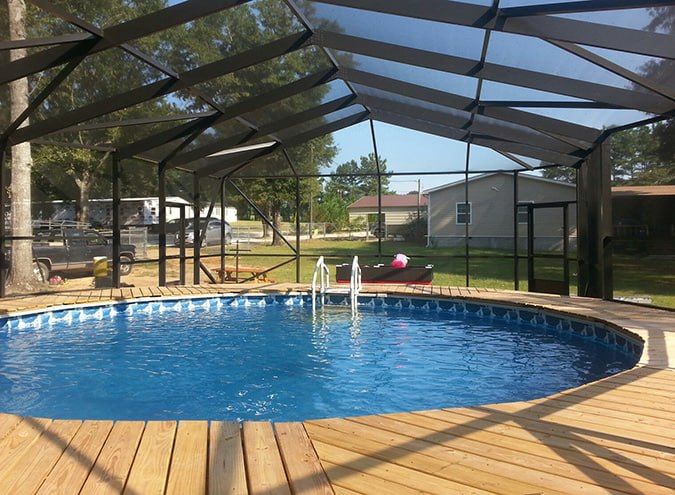
Saltwater Above Ground Pool in Melbourne: System Compatibility
Start Your Transformation
Quick Answer
Yes — a saltwater chlorine generator works on an above ground pool, and Right Way includes one standard on every above ground build. The catch is the pool wall. Salt destroys the galvanized steel used in most Big Box above ground kits, which is why our pools use a resin-coated structure built for salt from day one. Put a salt system on the wrong pool and you'll watch it rust out from the inside.
By the Right Way team — Florida-licensed pool contractor (CPC1461491) and screen-enclosure specialty contractor (SCC131153510 / SCC131153892), serving Central and Eastern Coastal Florida. Last updated: 2026-07-16.
Does a Salt System Actually Work on an Above Ground Pool?
Yes. A salt chlorine generator doesn't care whether your pool is above ground or in the dirt — it cares about water volume and flow rate. You dissolve salt in the water, the water passes through a cell, and the cell converts that salt into chlorine.
That's the part most homeowners get backwards. A saltwater pool is a chlorine pool. You're not swimming in something chlorine-free — you're just making the chlorine on site instead of hauling jugs of it home from the store.
The generator sizes to your gallons, and above ground pools are small by pool standards. Here's what that means in practice:
- A 24-foot round holds roughly 13,000 gallons — well inside the range of any entry-level residential salt cell.
- Your pump has to run long enough each day for the cell to produce a full day's chlorine. That's a runtime setting, not a hardware problem.
- The cell is a wear part. Ask for the manufacturer's hour rating on whatever model you're quoted.
The compatibility question isn't the equipment. It's what the salt is sitting against for the next fifteen years.
Why Salt Destroys a Big Box Above Ground Kit
Here's the honest version nobody at the warehouse tells you: most above ground pool kits are built on a galvanized steel wall . Galvanized steel and salt water are a bad marriage in any climate. In Florida they're a war zone.
Salt accelerates corrosion on bare and coated metal. Put a salt system in a steel-wall pool and the wall starts going from the water side, where you can't see it, behind the liner. By the time you spot a rust bloom or a soft spot near the bottom rail, the wall is already compromised.
This is the number one question we get on above ground pools: "won't the salt water rust the pool?" The answer depends entirely on what you bought.
Right Way's above ground pools use a resin-coated structure — engineered for saltwater systems and resistant to the rust that eats galvanized kits alive down here. The hardware is heavy-duty and built for salt-system service. Alongside the wall, that means:
- The structure is specified for salt from the factory, not "salt tolerant if you're careful."
- There's no galvanized wall behind the liner waiting to fail quietly.
- The saltwater chlorine system is included standard on our builds — we recommend it, and we don't charge you extra to want it.
One straight caveat, because we'd rather you hear it now than in year three: salt is still salt. Any bare metal you add to the pool area — a no-name ladder, an off-brand light ring, a heater with the wrong internals — is a corrosion target no matter how good the wall is. Spec the pool-side accessories for salt service.
Saltwater vs. Chlorine: What Actually Changes
We install both. We recommend salt. Here's the real comparison, not the sales version:
- Feel on skin and eyes. Salt is softer, with no chlorine bite. Traditional chlorine is sharper, especially after shocking.
- Weekly routine. Salt means checking the salt level and the cell. Chlorine means hauling, storing, and dosing it.
- What lives in your garage. A bag of salt, versus jugs of liquid chlorine or tabs.
- Wear items. Salt has a cell that gets replaced periodically. Chlorine has none, but you're buying chlorine forever.
- Up-front equipment. Salt costs more at install. Chlorine costs less.
The reason we push salt for families isn't the chemistry — it's the rhythm. The pool you actually swim in is the pool that isn't a chore. A salt system takes the weekly "did anyone put chlorine in?" argument off the table, which matters a lot more in July than any spec sheet does.
📌 What Makes an Above-Ground Pool Salt-Ready
- Resin-coated structure — not galvanized steel
- Heavy-duty hardware specified for saltwater service
- Salt chlorine generator sized to your pool's gallons
- Pump runtime set long enough to produce a full day's chlorine
- Salt-rated ladders, lights, and heater internals — the accessories matter too
Central and Eastern Coastal Florida trusted experts in custom pool construction, screen enclosures, concrete, pavers, and outdoor kitchens.
Call Today
(772) 758-5372
What Melbourne's Salt Air Adds on Top
Salt in your pool is one conversation. Salt in your air is a different one, and in Brevard you get both.
If you're east of US-1 — Indialantic, Melbourne Beach, Satellite Beach, or anywhere out toward A1A — you're taking airborne salt load on everything metal in the yard, pool or no pool. Inland toward Wickham Road, Suntree, and Viera it eases off, but it never goes to zero.
That doesn't change whether a salt system works. It changes what you should spec around it:
- Equipment pad placement. Don't tuck the pad where salt spray and prevailing wind hit it broadside if you have a sheltered option.
- Rinse discipline. Fresh-water rinsing metal fixtures near the pool is free and it works.
- Screen enclosure hardware. If you're adding a screen enclosure, this is where high-grade stainless steel earns its money — that's our build standard on enclosures, because galvanized rusts in Florida humidity.
We have a companion piece on what airborne salt does to a beachside pool build — read Salt Air & Your Pool: Why Beachside Brevard Builds Are Different for that side of it. This page is about what's dissolved in your water.
Retrofitting Salt onto a Pool You Already Own
Thinking about converting the pool already in your yard? Check one thing first: what is the wall made of?
Pull the top rail cap or check your original paperwork. If the answer is galvanized steel, converting to salt is a decision to shorten the life of the pool — it might take years, but it'll happen where you can't inspect it.
If the wall is resin, a conversion is straightforward:
- Confirm the wall and hardware are rated for salt service — in writing from the manufacturer, not from a forum post.
- Size the generator to your actual gallons, not a guess based on pool diameter.
- Add salt to the manufacturer's target level and circulate it fully before you fire the cell.
- Replace any metal component in the water that isn't salt-rated — ladder, light, fittings.
Honest answer on a steel-wall pool: the money is better spent on a pool built for salt than on a system that will quietly eat the one you have.
What It Costs and How Fast You're Swimming
Right Way's above-ground packages are all-inclusive — pool, pad, engineering, permit, electrical, and inspection — and the saltwater chlorine system is included as standard. The price is the same in Melbourne as it is anywhere else we work. We don't run geo-based upcharges. Our price starts at $12,500 for a 15-round above-ground pool.
Add a wood or composite deck for $5,000–$10,000, or a screen enclosure for $20,000–$28,000. Financing is available through our financing partners for qualified homeowners.
On timing: from delivery to first swim in under 7 days. One clarification we make on every job, because we'd rather be straight with you than sell a number — that clock starts once the permit is in hand. The permit window belongs to the building department, not to us. For a Melbourne address, check with the City of Melbourne Building Department on their current window; your total project is that window plus our install week.
While you're planning the surround, remember that salt splash-out lands on whatever deck you put around the pool. If you're weighing finishes, cool decking options for a pool deck is worth a read before you commit — surface temperature and salt exposure are both real in a Brevard July.
Get a Straight Answer on Your Melbourne Pool
You shouldn't need a chemistry degree to figure out whether the pool in your yard can take a salt system. Ask us what the wall is made of, ask what's included, and get a number that doesn't move after the truck shows up. One team pulls the permit, levels the pad, sets the pool, plumbs it, wires it, and hands you the keys — across Melbourne, Palm Bay, Viera, and the rest of Brevard.
Call (772) 758-5372 or schedule a consultation at rightwayenclosures.com.
One team. One design. One timeline.
FAQs
Will a saltwater system rust my above ground pool?
Not if the wall is resin. Salt corrodes the galvanized steel used in most Big Box above-ground kits, which is exactly why Right Way builds on a resin-coated structure engineered for saltwater from the factory. Ask any installer what your wall is made of before you add salt to it.
How much salt goes into an above ground pool?
Follow your generator manufacturer's target level, which is a fraction of ocean strength — a salt pool tastes barely salty, not like the Atlantic at Melbourne Beach. Right Way sets the level and circulates it fully before the cell is fired, then hands you the numbers at walkthrough.
Does a saltwater above ground pool cost less to maintain than chlorine?
Usually, day to day. You stop buying and storing chlorine, and the weekly routine drops to checking salt and the cell. Against that, the salt cell is a wear part you eventually replace. Most Brevard families we build for take that trade happily.
Can I add a salt system to the above ground pool I already have?
Yes, if the wall is resin and rated for salt service. If it's galvanized steel, converting will corrode the wall from the water side where you can't inspect it. Check your paperwork first — it'll tell you straight if your pool is a candidate.
Does salt air in Melbourne affect a saltwater pool differently?
It affects the metal around the pool, not the water chemistry. East of US-1 toward Indialantic and Melbourne Beach, airborne salt loads every metal fixture in the yard. Spec salt-rated accessories, place the equipment pad out of direct spray, and rinse metal fittings with fresh water.
Related services: Above-Ground Pool Installation · Pool Screen Enclosures · Melbourne Outdoor Living